

Most professionals make the same critical resume mistake: they list what they were responsible for instead of what they actually accomplished. Hiring managers and AI screening tools see hundreds of resumes packed with identical-sounding duties. What cuts through the noise is measurable, specific achievement statements that prove your real-world impact. This article breaks down exactly why achievement-focused resumes perform better, how to write them using proven frameworks, how to make them visible to AI systems, and what mistakes to avoid so your resume reaches the right hands.
Table of Contents
- Why achievements matter more than duties on your resume
- How to craft powerful achievement statements
- Navigating AI resume screening: Maximizing achievement visibility
- Avoiding common mistakes when listing achievements
- Why the best resumes balance authenticity with optimization
- Boost your resume with achievement-focused templates
- Frequently asked questions
Key Takeaways
| Point | Details |
|---|---|
| Achievements get results | Highlighting achievements on your resume shows impact and stands out with both human recruiters and AI tools. |
| Quantify with numbers | Use data, percentages, or clear outcomes to make your achievements tangible and memorable. |
| Balance AI keywords and authenticity | Optimize for keywords without sacrificing clarity or telling genuine stories. |
| Avoid common mistakes | Be specific, honest, and relevant in your achievement statements to increase credibility. |
| Leverage templates and tools | Modern resume templates and AI editors help structure your achievements for maximum recruiter impact. |
Why achievements matter more than duties on your resume
With awareness of this common pitfall, it's essential to understand how framing can drastically affect your resume's effectiveness.
There's a key difference between a duty and an achievement. A duty describes what your job required you to do. An achievement describes what you actually delivered. "Responsible for managing social media accounts" is a duty. "Grew Instagram following by 42% in six months by implementing a consistent content calendar" is an achievement. One tells a recruiter your job existed. The other tells them you were good at it.
Recruiters read resumes in an average of six to seven seconds before deciding whether to continue. In that window, they're not scanning for job titles or task lists. They're looking for signals of impact. Duties tell the reader nothing about your capability or results. Achievements show them both at once. Human recruiters value authenticity and accomplishments far more than generic task descriptions.
AI applicant tracking systems, which most mid-to-large companies use to pre-screen resumes, are trained to identify signals of relevance and quality. Quantified achievements align more naturally with the scoring criteria these systems use because they contain specific metrics, outcome-oriented language, and stronger keyword density tied to real results. AI resume templates are designed precisely to help you surface these kinds of statements in the right structure.
Here's a direct comparison to make this concrete:
| Duty statement | Achievement statement |
|---|---|
| Managed customer service team | Led a 12-person customer service team, reducing response time by 35% over 8 months |
| Handled sales calls | Closed $180K in new business in Q3 by refining outreach scripts and follow-up cadence |
| Assisted with project management | Coordinated cross-functional delivery of a $500K software rollout, completed 2 weeks ahead of schedule |
| Responsible for training new staff | Designed onboarding program that cut new hire ramp-up time from 6 weeks to 3 weeks |
The right column doesn't just sound better. It is better, because it gives the reader evidence rather than expectation.
"Recruiters aren't looking to confirm your job existed. They're looking to understand whether you made a difference while you were there."
Pro Tip: When reviewing your existing resume, circle every sentence that begins with "Responsible for" and rewrite each one using a result-based structure. This single exercise will transform your resume faster than any formatting change.
How to craft powerful achievement statements
Now that the importance of achievements is clear, let's discuss how to actually write these statements effectively.
The STAR method is the most reliable framework for turning a bland duty into a compelling achievement. STAR stands for Situation, Task, Action, Result. You don't always need all four components in one bullet point, but thinking through all of them ensures you capture the full story before editing it down to a punchy statement.
Here's how to apply it step by step:
- Identify the situation. What was the context? Was there a problem, a gap, or an opportunity? For example: "Customer churn was increasing quarter over quarter."
- Clarify your task. What were you personally responsible for? "I was tasked with analyzing churn patterns and proposing solutions."
- Describe your action. What specifically did you do? "I implemented a proactive outreach program targeting at-risk accounts using CRM data."
- Quantify the result. What changed? "Reduced churn by 18% within two quarters, retaining an estimated $220K in annual recurring revenue."
Compress those four steps into one bullet: "Reduced customer churn by 18% by implementing a CRM-driven outreach program, retaining $220K in annual recurring revenue." That's a statement that works for both a human reader and an AI screening system.
Achievements that are specific and measurable resonate best with human recruiters and AI systems alike. The more concrete your numbers, the more trustworthy and credible your statement becomes.

Here are some before-and-after transformations to see this in practice:
| Before (duty) | After (achievement) |
|---|---|
| Wrote marketing copy | Wrote email campaigns that achieved a 34% open rate, 12% above industry average |
| Supervised warehouse operations | Supervised daily operations for a 40,000 sq ft warehouse, maintaining 99.3% inventory accuracy |
| Supported HR processes | Streamlined recruitment workflow using ATS tools, cutting time-to-hire from 45 to 28 days |
| Managed vendor relationships | Renegotiated 3 vendor contracts, saving the company $85K annually |
Notice that every "after" statement starts with a strong action verb. Verbs like "reduced," "launched," "generated," "streamlined," and "led" immediately position you as someone who does things, not someone things happen around. The AI resume editor on Prezumi can help you identify weak verbs and suggest stronger, more impactful alternatives automatically.
If you find yourself stuck quantifying your work, think about frequency, scale, and scope. How many people did you serve? How large was the budget? How often did you perform this task? These proxy numbers add specificity even when hard performance metrics aren't available. For deeper guidance on framing your overall professional narrative, profile presentation strategies can provide a helpful foundation.
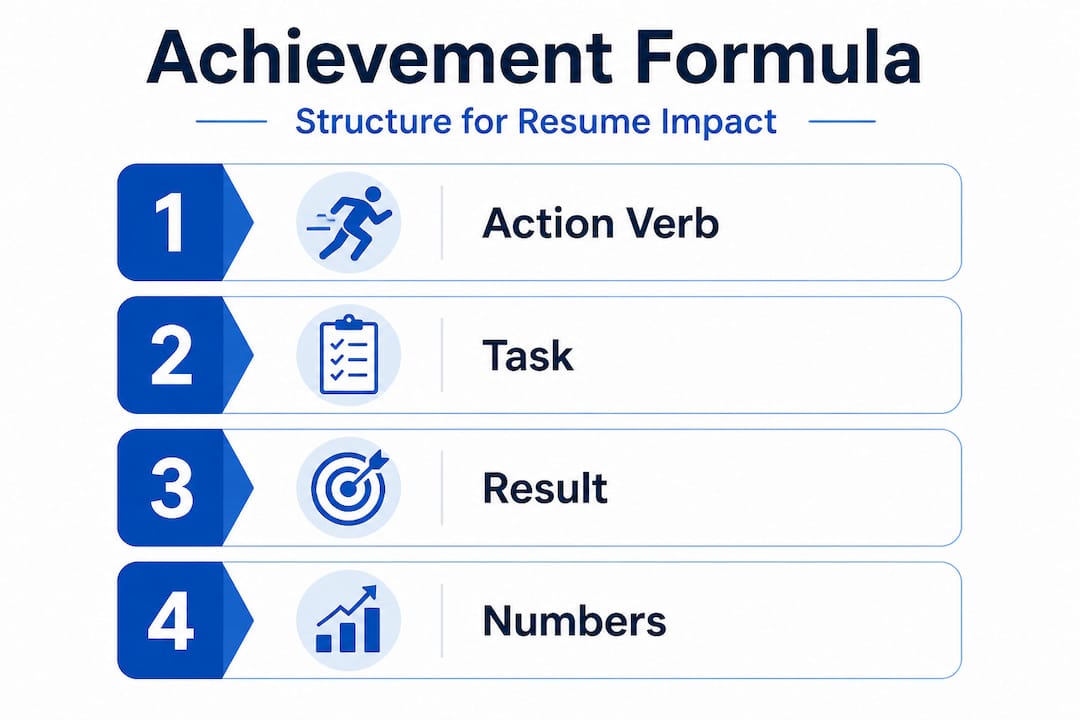
Pro Tip: Start every achievement bullet with an action verb and end it with measurable impact. This structure works like a formula: Action + Context + Result. Apply it consistently and your resume will read with energy and credibility from top to bottom.
Navigating AI resume screening: Maximizing achievement visibility
Crafting achievement statements is only part of the equation. Making sure they make it through AI systems is the next challenge.
Most companies with more than 50 employees use some form of AI-powered ATS to screen incoming resumes before a human ever sees them. These systems parse your resume for keywords, structure, relevance to the job description, and evidence of impact. If your achievements are buried in dense paragraphs, formatted in complex tables, or written without role-relevant language, the system may score you lower than your actual qualifications deserve.
Here's how to make your achievements ATS-friendly without sacrificing quality:
- Use standard section headers. Labels like "Work Experience" and "Professional Summary" are universally recognized by ATS software. Creative labels like "My Journey" or "Career Story" may confuse parsing algorithms.
- Write achievements in plain bullet points. One achievement per bullet keeps the content clean and digestible for both machines and humans.
- Mirror the job description language. If the posting says "cross-functional collaboration," use those exact words in your achievement statements where they apply naturally.
- Include role-relevant keywords within the achievement. Don't just say you improved efficiency. Say you "improved warehouse picking efficiency by 22% using lean inventory methods." The specificity adds both keywords and credibility.
- Avoid text in images or tables that ATS tools can't read. Keep critical content in the main body text of your resume.
AI resume tools should be used for keyword and impact focus, but not to the point of overwriting your genuine achievement descriptions. Over-optimizing can strip the humanity from your resume, leaving it feeling robotic and hollow to the human reviewers who ultimately make hiring decisions.
One important finding worth highlighting: AI optimization, when applied thoughtfully, boosted resume fit scores by up to 28 points in controlled testing. That kind of improvement can be the difference between passing or failing the initial screening stage. Prezumi's ATS-ready resumes and AI-powered Europass resume builder are both structured to help you hit that sweet spot between keyword visibility and authentic storytelling.
The bottom line: your achievements need to be both machine-readable and human-compelling. You're writing for two audiences simultaneously, and understanding that dual requirement is what separates a strategic job seeker from one who just updates their resume occasionally and hopes for the best.
Avoiding common mistakes when listing achievements
Even with great intent, some missteps commonly undermine achievement statements. Here's how to avoid them.
The most frequent mistake is vagueness disguised as achievement language. Saying "significantly improved team performance" sounds like an achievement but tells the reader absolutely nothing they can evaluate. How much improvement? Over what timeframe? What did you actually change? Vague statements erode trust instead of building it.
Here are the most common pitfalls and how to fix them:
- Vague language without evidence. Replace "improved customer satisfaction" with "improved customer satisfaction scores from 74% to 91% over two quarters."
- Irrelevant achievements. Listing results that have no connection to the role you're applying for wastes valuable resume space. Tailor your achievements to the job's core requirements.
- Exaggeration or inflation. Claiming you "single-handedly" achieved something when it was a team effort is a red flag if it comes up in an interview. Be accurate about your contribution level.
- Buzzword overload. Phrases like "synergized cross-departmental excellence" mean nothing to anyone. They signal that you're filling space, not communicating results.
- Over-reliance on AI-generated language. Over-reliance on AI resume tools can reduce authenticity, which is still highly valued by human recruiters. AI can draft and suggest, but your voice and real experiences need to shape the final product.
- Passive construction. "Results were achieved by managing..." puts the action at a distance. Own your impact directly: "Managed... and achieved..."
The best use of resume editing tips is to treat them as a quality filter. After writing your achievements, read each one out loud. If it sounds like it could apply to anyone in your field, it's not specific enough. If it sounds like it describes your actual work, you're on the right track.
Pro Tip: After writing each achievement statement, ask yourself: "Could I prove this in an interview?" If the answer is yes, it belongs. If you'd struggle to back it up with a real story, revise or remove it.
Why the best resumes balance authenticity with optimization
Here's the tension that most resume advice ignores: the push toward AI optimization has made many resumes technically better but personally worse. They pass ATS filters. They hit the keywords. And then a recruiter reads them and feels nothing.
The job seekers we see succeed most consistently aren't the ones with the most keyword-dense resumes. They're the ones who figured out that AI optimization for resumes is a tool, not a strategy. The strategy is your career story. The tool helps you tell it in a format that gets past the first gate.
Think of it this way: a recruiter who sees 200 resumes a week has developed a finely tuned sense for what's real and what's been generated or inflated. The resumes that get interviews tend to have a clear point of view. They show a professional who made deliberate choices, faced real challenges, and produced specific outcomes. That kind of voice doesn't emerge from a template alone. It comes from you knowing your own value clearly enough to state it directly.
What most job seekers miss is that neither pure automation nor pure personal storytelling is sufficient on its own. You need AI-powered resume editing to handle structure, keyword alignment, and formatting efficiency. But you also need to bring your real results, your genuine voice, and the specific details that make your experience different from everyone else's. The combination is what creates a resume that gets past the algorithm and gets a call back.
The future of hiring will continue to involve AI at the screening stage. That's not going away. But the human decision to invite someone in for an interview will always come down to whether the resume told a believable, compelling story about a real person. Authentic achievement storytelling is not just a nice-to-have. It is the long game.
Boost your resume with achievement-focused templates
For readers ready to put these principles into action, here are resources that make achievement-first resumes easier than ever.
Prezumi's template library is built to make your achievements the centerpiece of every resume, not an afterthought buried in a list of duties. Every layout is structured to lead with impact and support readability for both ATS systems and human reviewers.
Try the clean and professional Minimal Resume Template for a distraction-free format that keeps achievement statements front and center. If you prefer a more structured visual layout that guides recruiters through your results clearly, the Blueprint Resume Template is built for exactly that. Both are ATS-optimized and recruiter-ready. Browse the full collection of AI Resume Templates to find the format that fits your industry and career level, then let Prezumi's AI tools help you sharpen every achievement statement before you send it out.
Frequently asked questions
How do I quantify achievements if my work isn't number-driven?
Focus on scope, frequency, or qualitative impact. You can describe the scale of a project, the frequency of a process you improved, or the feedback you received from stakeholders to demonstrate real-world results.
What's the biggest mistake to avoid when listing achievements?
Avoid vague, generic phrases and any form of exaggeration. Human recruiters value authenticity and clarity over impressive-sounding claims that can't be substantiated.
Should I tailor achievements for every job application?
Yes, always. Match your achievement statements to the specific language and priorities in the job description, since AI resume tools can help you identify the right keywords to incorporate for each application.
What is the STAR method for resume achievements?
STAR stands for Situation, Task, Action, Result. It's a framework for structuring your achievement stories so they include context, your role, what you did, and the outcome you produced.
How can AI tools help improve my achievement statements?
AI tools can suggest stronger keywords, flag weak verbs, and help format your achievements for ATS compatibility. That said, AI optimization improves keyword focus best when combined with your own review to preserve the authenticity that human recruiters still prioritize.