

You spend hours tailoring your resume for one job posting, then repeat the entire process for the next. Every application feels like starting from scratch, and somewhere between matching keywords and sounding human, the whole thing falls apart. The challenge isn't effort. It's strategy. Modern job seekers are competing against Applicant Tracking Systems (ATS), which are automated filters that scan resumes before a recruiter ever reads them, and against a flood of other candidates doing the exact same thing manually. This article walks you through how to generate powerful resume content ideas, which categories matter most, how AI tools accelerate the process, and how to make every output feel authentically yours.
Table of Contents
- How to brainstorm powerful resume content ideas
- Top resume content categories to showcase your value
- AI-powered tools and strategies for crafting standout resume content
- How to personalize your AI-generated resume content for real results
- Our expert take: The new rules for resume content in 2026
- Ready to put these ideas into action?
- Frequently asked questions
Key Takeaways
| Point | Details |
|---|---|
| AI boosts resume fit | Using AI-driven tools increases ATS fit, saving hours while enhancing keyword relevance. |
| Content quality matters | Prioritize impactful achievements and relevant skills to stand out to recruiters and algorithms. |
| Balance AI with personalization | Manual edits and authentic details ensure your resume feels both smart and sincere. |
| Templates accelerate results | ATS-ready templates and idea banks speed up customization for multiple applications. |
How to brainstorm powerful resume content ideas
Generating great resume content starts before you open a blank document. The most effective approach combines three methods: job ad keyword mining, AI bullet generators, and a personal SWOT self-assessment (Strengths, Weaknesses, Opportunities, Threats).
Job ad keyword mining is exactly what it sounds like. Copy the job description into a text tool and identify the words that repeat. These are the terms the ATS is programmed to prioritize. If "cross-functional collaboration" appears three times, it belongs on your resume, ideally in context with a real example.
AI bullet generators take your raw experience and reshape it into polished, structured statements. Instead of writing "managed a team," the AI might produce "led a six-person team that delivered a product launch 12% under budget." The difference is specificity, and specificity is what gets resumes past both algorithms and humans. Using AI resume editor tips from platforms built for this purpose can significantly reduce how long that process takes.
SWOT self-assessment grounds the brainstorm in reality. Before generating anything, spend ten minutes listing your strongest skills, the gaps you are working on, the roles you are targeting, and the competitors you are up against in your field. This gives AI tools better input, which means better output.
One finding worth noting: AI tools boost ATS fit by 28 points compared to manual tailoring, which is a substantial edge when you are competing in high-volume hiring pipelines. Pair that with AI in recruiting best practices and you have a system, not just a document.
- Mine 3 to 5 job ads per role for overlapping keywords
- Use AI generators to draft 8 to 10 bullets per position, then select the best
- Run a quick SWOT before each application cycle, not just once
- Validate your skills list against industry-specific job boards
Pro Tip: Build a running "idea bank" in a shared doc or notes app. Every time you write a strong bullet or find a compelling phrase, save it. Over time, this bank becomes your personal content library that you can pull from for any application without starting over.
Top resume content categories to showcase your value
With idea generation underway, let's break down which content categories drive the most impact on 2026 resumes. Not all resume sections carry equal weight. Hiring managers and ATS platforms both favor specific types of content, and knowing the difference can move your application from the rejection folder to the interview queue.
The highest-impact categories right now are:
- Quantifiable achievements: Numbers do the heavy lifting. "Increased email open rates by 34%" is far stronger than "improved email marketing."
- Skills with measurable context: List a skill and immediately follow it with the result it produced. "Python scripting, reduced data processing time by 40%."
- Leadership and ownership language: Words like "led," "owned," "launched," and "spearheaded" signal initiative, not just participation.
- Project portfolios and case studies: Even a two-sentence description of a project you built from scratch signals capability that a job title alone cannot.
- Recent learning and certifications: Showing you completed a relevant course or earned a certification in the past 12 months signals adaptability, which is a top recruiter priority in 2026.
- Soft and technical skill combinations: ATS systems increasingly reward candidates who can demonstrate both people skills and technical know-how within the same bullet.
Semantic matching, where an ATS evaluates the meaning behind your words rather than just exact keyword matches, is becoming the norm. Resume2Vec outperforms traditional ATS in semantic match and candidate ranking, which means your content needs to reflect genuine expertise, not just stuffed keywords. Exploring ATS-ready template examples can show you how the right structure supports this kind of deeper matching. The ATS efficiency and fairness conversation is also evolving, and knowing where the technology is headed gives you a strategic edge.
"Your resume is not a history document. It is a marketing document. Every line should answer the question: why does this matter to the person reading it?"
Pro Tip: Structure every bullet using the format: action verb + result + metric. For example, "Streamlined onboarding workflow, cutting new hire ramp-up time by three weeks." This format works for both AI scanners and human readers.

AI-powered tools and strategies for crafting standout resume content
After understanding what to include and why, here's how top AI tools are changing the resume writing game. The gap between manual resume tailoring and AI-assisted work is not just about speed. It is about quality and consistency across every application you send.
| Factor | Manual editing | AI-assisted editing |
|---|---|---|
| Time per application | 90 to 120 minutes | 15 to 25 minutes |
| ATS keyword accuracy | Moderate | High |
| Bullet specificity | Variable | Consistently strong |
| Personalization risk | Low risk, high effort | Needs human review |
| Scalability across jobs | Difficult | Very easy |
The numbers tell a clear story. AI solutions cut resume tailoring time from over 8 hours to just 62 minutes for 20 job applications, with an 11.5% increase in ATS fit. That is not a minor improvement. That is a fundamental shift in how you compete. The benefits of AI automation extend well beyond hiring, but in the resume context, they are especially clear.
Here is how to use AI tools step by step for maximum content impact:
- Extract keywords: Paste the job description into your AI tool and ask it to identify the top 10 to 15 skills and phrases.
- Generate bullets: Feed your work history and the extracted keywords into the generator. Ask for 5 variations per role.
- Rank and select: Read each output and flag the ones that feel most accurate and specific to your actual experience.
- Customize achievements: Swap generic placeholders for your real numbers. If the AI says "improved sales," you replace it with "grew Q3 sales by $220,000."
- Check for repetition: AI tools sometimes reuse phrases. Review the full resume for redundancy before sending.
The most common AI resume mistake is accepting the first output without editing. Generic results and vague language are signs that the tool had insufficient input. Garbage in, garbage out still applies. You can try an AI editor that is purpose-built for resume content if you want structured prompts that reduce the guesswork. Also review AI resume template options to find layouts that match the roles you are targeting.
How to personalize your AI-generated resume content for real results
Once you have strong AI-generated material, the final step is making your resume truly your own. AI is excellent at structure. It is less reliable at soul. That is where you come in.
Recruiters can spot generic content, and a resume that passes ATS but reads like a template will still get screened out in the human review phase. Personalization is the bridge between algorithmic approval and actual interviews. The role of maintaining fairness with AI in hiring also means that authentic, accurate content is rewarded more than keyword stuffing.
Here is a step-by-step workflow to personalize without losing the efficiency gains:
- Review with fresh eyes: After generating your AI draft, step away for 30 minutes. Return and read it as if you were the recruiter. Does it sound like a real person?
- Replace placeholders with proof: Any bullet that lacks a specific number, project name, or outcome needs your input. Add it.
- Inject industry language: Every field has its own vocabulary. A product manager at a SaaS company sounds different from one at a logistics firm. Adjust accordingly.
- Validate against the actual job ad: Match your final resume line by line against the job description. Every major requirement should appear somewhere in your document.
- Cross-reference with your LinkedIn profile: Your LinkedIn is public and often checked. If your resume says one thing and your profile says another, it creates doubt.
Pro Tip: Pull two or three endorsements or recommendations from LinkedIn and use them as inspiration for how others describe your work. Sometimes the language someone else uses to describe you is more compelling than what you would choose yourself.
For visual inspiration, minimal template inspiration and unique portfolio layouts can help you see how structure and content work together to make a stronger impression.
Our expert take: The new rules for resume content in 2026
Bringing it all together, here is our hard-earned perspective on what actually moves the needle now. Everyone talks about using AI. Fewer people talk about knowing when not to. The real edge in 2026 comes from understanding that AI handles volume and structure, but you handle proof and personality.
Hyper-personalization beats generic AI output every time, even when that output clears the ATS. A recruiter who reads 200 resumes a day can feel when a document was assembled versus written. The candidates who stand out are the ones whose resumes read like evidence, not claims. They do not say "strong communicator." They say "presented quarterly strategy to a 40-person executive team for three years."
Our practical advice: test your resume on real platforms and in real applications, not just on ATS simulators. Simulators tell you about keyword density. Real applications tell you about response rates. Track your data. If a version of your resume generates more callbacks, that is your control version. Iterate from there, using editor strategies that work to keep refining without starting from scratch each time.
Ready to put these ideas into action?
You now have the framework: generate ideas strategically, prioritize the content categories that matter most, use AI to accelerate the work, and personalize every output so it sounds like you. The next step is putting it into practice without spending another weekend on a resume that may or may not land.
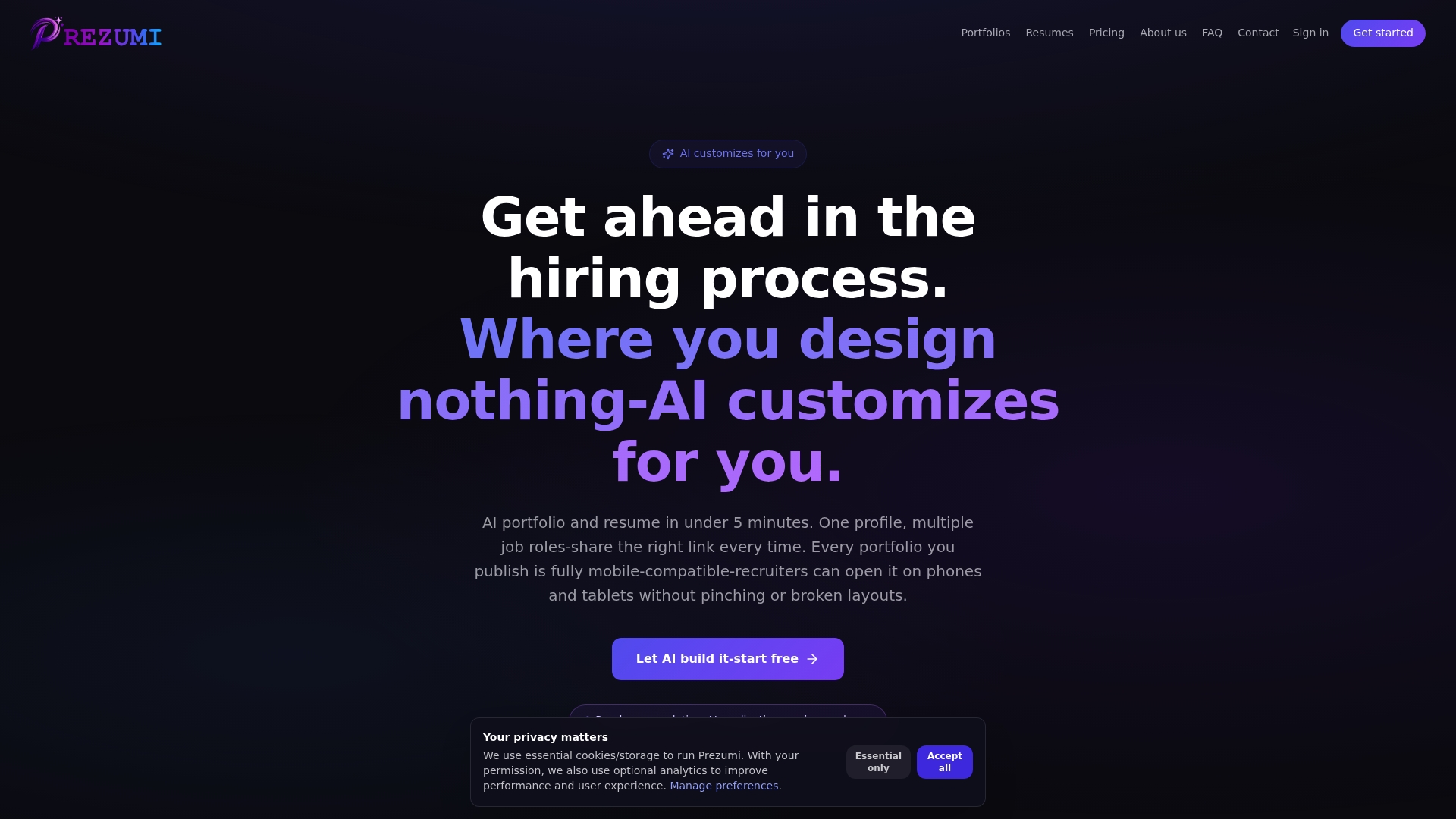
Prezumi gives you explore resume templates built around ATS best practices and role-specific needs, so you are not designing from a blank page. You can also try our AI editor to generate, refine, and customize your content in minutes. Most users have a recruiter-ready resume live in under five minutes. That is not a promise of a job. It is a promise of a faster, smarter starting point.
Frequently asked questions
What are the top three resume content areas recruiters prioritize in 2026?
Recruiters focus most on quantifiable achievements, relevant skills with context, and recent learning or certifications. Platforms using semantic matching technology increasingly reward content that reflects genuine expertise over keyword stuffing.
How do AI resume tools improve ATS match rates?
AI resume tools extract job-specific keywords and restructure your experience to match role requirements more precisely. This approach can boost ATS fit by 28 points compared to manual tailoring alone.
How can I avoid generic, AI-sounding resumes?
Personalize every AI-generated bullet by replacing vague language with specific numbers, project names, and real outcomes. Recruiters detect generic AI content quickly, so the human editing step is not optional.
Is it worth using portfolio templates alongside my resume?
Yes. Pairing a modern portfolio with your resume significantly increases your credibility and visibility, especially in creative, technical, or freelance fields where showing work beats describing it.