

Sending the same resume to every job opening feels efficient. It's not. Recruiters can spot a generic resume instantly, and applicant tracking systems are even less forgiving. The truth is, a one-size-fits-all resume quietly filters you out before a human ever reads your name. Customizing your resume for each role is not extra work for its own sake. It's the single most effective way to get your application past automated filters, land in front of a recruiter, and ultimately secure the interview you're working toward.
Table of Contents
- What does it mean to customize your resume?
- Why does customization matter for ATS systems and recruiters?
- How to effectively tailor your resume for each job
- Comparison: Generic resumes vs. customized resumes
- What most people get wrong about resume customization
- Make resume customization easy with AI templates
- Frequently asked questions
Key Takeaways
| Point | Details |
|---|---|
| Customization beats generic | Customizing your resume for each job significantly improves your odds of interview callbacks. |
| ATS-friendly design matters | Simple formatting and standard fonts help your resume get past automated filtering. |
| Keywords boost relevance | Including employer-specific skills and keywords increases your visibility to recruiters and ATS. |
| Test before you send | A plain-text check ensures your resume’s structure and data won’t break in submission systems. |
What does it mean to customize your resume?
Real resume customization is not about rewriting your entire work history every time you apply somewhere. It's about making deliberate, strategic adjustments so your resume directly addresses what each employer is looking for. Think of it as translating your experience into the specific language of each job posting.
Most people confuse customization with surface-level edits. Swapping out a job title or changing the company name in a cover letter is not customization. Strategic tailoring means you're pulling out the specific skills, responsibilities, and outcomes from a job description and reflecting them clearly in your resume's professional summary, skills section, and bullet points.
What customization actually involves:
- Reading the job description carefully and identifying required versus preferred skills
- Mirroring the exact language the employer uses for key responsibilities
- Reordering your skills or experience sections to highlight the most relevant items first
- Adjusting your professional summary to speak directly to the role's core needs
- Removing irrelevant experience that may dilute your focus for that specific job
A common mistake that even experienced applicants make is prioritizing visual flair over function. Fancy tables, multi-column layouts, icons, and stylized headers look impressive in a PDF viewer but can completely break down inside an ATS (applicant tracking system, the software that scans and ranks resumes before a recruiter sees them). According to ATS formatting guidance, single-column layouts with standard fonts and no tables or images are essential for ATS compatibility. Using ATS-ready resume templates from the start removes this risk entirely.
Why does customization matter for ATS systems and recruiters?
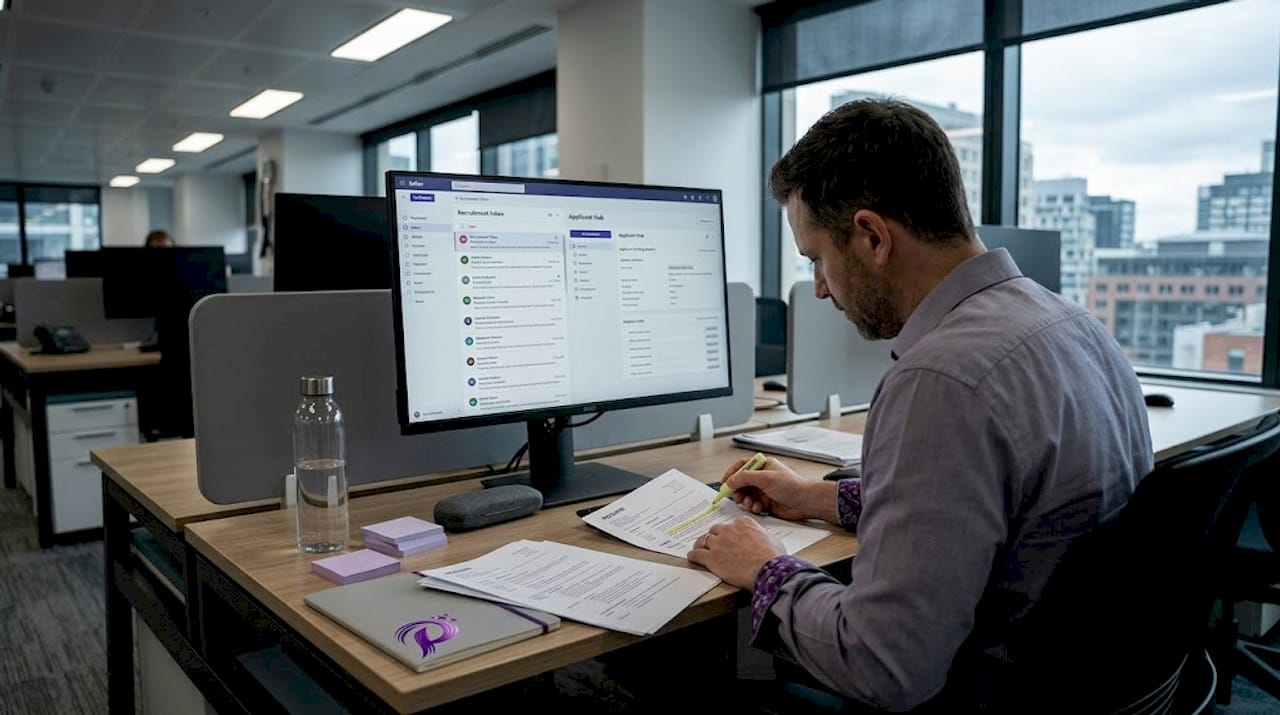
The hiring process has changed dramatically. Most mid-to-large companies now run every resume through an ATS before a recruiter touches it. These systems parse your resume, extract information, and score how well you match the job requirements. If your resume doesn't include the right keywords in the right context, it scores low and gets buried.
Here's how the stakes break down in a typical hiring funnel:
| Stage | What happens | Impact of customization |
|---|---|---|
| ATS scan | Keywords and formatting checked | High: wrong words or broken format = rejection |
| Recruiter review | Relevance scanned in 6 to 10 seconds | High: clear match = continued reading |
| Hiring manager review | Skills and culture fit assessed | Medium: context and specifics evaluated |
| Interview invitation | Decision made based on fit | Positive: tailored resume increases invite rate |
Recruiters typically spend six to ten seconds on an initial resume scan. That's not a lot of time for a generic document to make a case. A customized resume puts the most relevant information in the most visible positions, so even a quick scan communicates fit.
"A well-customized resume isn't just keyword stuffing. It's a strategic document that mirrors the employer's language and priorities, making it easy for both software and humans to quickly confirm you're the right fit."
Complex formatting is one of the fastest ways to lose points with an ATS. Tables, headers, footers, text boxes, and embedded images are invisible to most ATS software. The system either skips that content or misreads it, which can corrupt your contact information or wipe out entire skill sets. An ATS-compliant resume template eliminates this issue from the start.
Pro Tip: Run a plain-text test on your resume. Paste the entire document into Notepad or a similar plain-text editor. If your sections and dates are intact and readable, your resume is likely safe for ATS parsing. If it looks scrambled, the formatting needs work before you submit anywhere.
How to effectively tailor your resume for each job
Here is a practical, repeatable framework you can use every time you apply for a new position. This process does not have to take hours. With the right structure in place, targeted customization can take as little as fifteen to twenty minutes per application.
-
Read the job description twice. On the first read, get the big picture. On the second, highlight every specific skill, tool, and responsibility mentioned. Pay attention to words that appear more than once. Employers often repeat their highest priorities.
-
Build a master resume. Keep one document with everything: all your roles, skills, achievements, and certifications. This is your source document. You pull from it and never submit it directly.
-
Edit your professional summary first. This is the first thing a recruiter reads. It should directly echo the job's core requirements using similar language. If the job posting says "cross-functional collaboration," your summary should mention working across teams, not just "team player."
-
Match your skills section to the posting. Move the skills most relevant to this role to the top. Remove skills that are completely unrelated to this position. A marketing role does not need to feature your expertise in logistics software.
-
Revise bullet points for relevance and impact. Lead with action verbs. Quantify results wherever possible. "Increased organic traffic by 38% in six months" is far stronger than "managed SEO efforts." Align the outcomes you highlight with what this employer values most.
-
Use a clean, single-column layout. According to ATS formatting best practices, single-column resumes with standard fonts are consistently the safest choice. Try a minimal resume template if you need a clean starting point, or a metro resume layout for a slightly bolder but still ATS-safe design.
-
Run the plain-text test. Before you submit, paste your resume into a plain-text editor. Check that all sections, dates, and contact details are intact and in the correct order.
-
Save in the correct format. Most employers accept PDF or DOCX. Check the job posting for preferences. If no format is specified, PDF is generally the safer choice as it preserves your visual formatting for human reviewers.
Pro Tip: Create a simple spreadsheet to track which version of your resume you sent to which company. If you get a callback, you'll know exactly what worked and can replicate it.
Comparison: Generic resumes vs. customized resumes
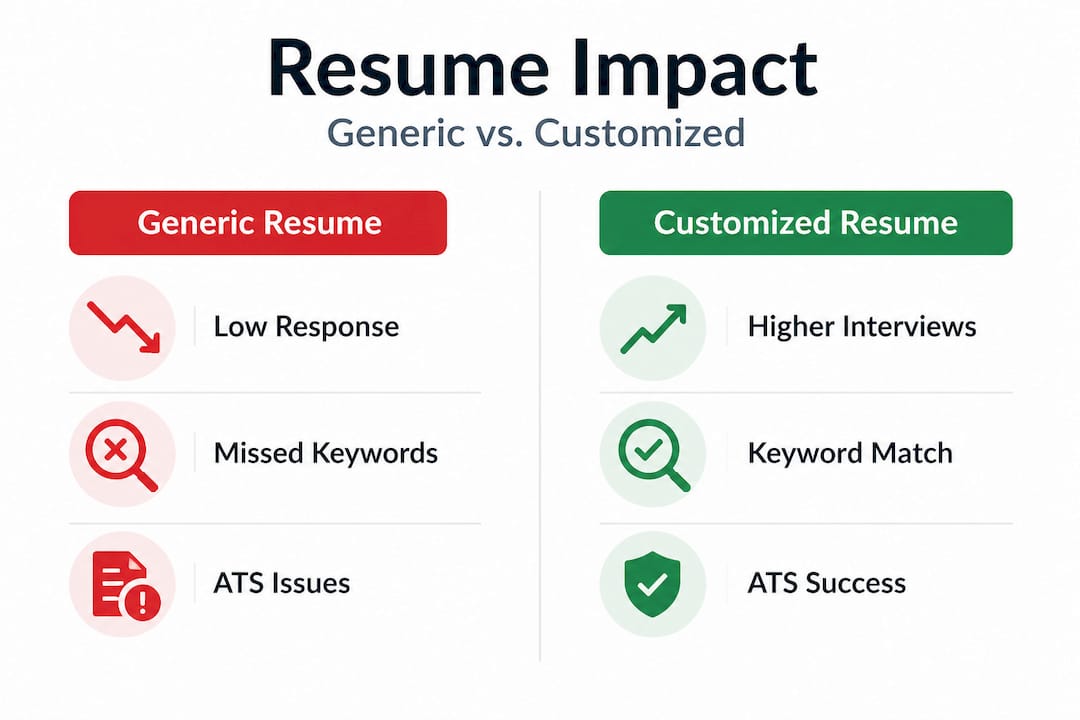
The difference in outcomes between a generic and a customized resume is not small. It's significant enough that career experts consistently identify customization as one of the top controllable factors in job search success.
| Factor | Generic resume | Customized resume |
|---|---|---|
| ATS keyword match | Often low, misses role-specific terms | High, mirrors job description language |
| Recruiter relevance | Unclear fit, requires interpretation | Immediately clear fit for the role |
| Professional summary | Vague and general | Directly addresses employer's core needs |
| Skills section | Fixed list, not role-specific | Reordered and trimmed to match the posting |
| Interview callback rate | Noticeably lower | Significantly higher |
| Time to create | Fast (one document for all) | Moderate (15 to 20 minutes per application) |
The numbers support this clearly. Job seekers who tailor their resumes for each application consistently report higher response and interview rates compared to those using a single static document. Research and career coaching data repeatedly confirm that resume keyword alignment with the job description is one of the strongest predictors of ATS success.
Statistic highlight: Studies in recruitment research show that tailored resumes can be up to three times more likely to result in an interview callback compared to generic submissions, simply because they speak directly to what the employer prioritized in their posting.
The time investment is the most common objection. People assume customizing means hours of work. In reality, with a solid master resume and a clean template, most customizations take under twenty minutes. Contrast that with the time you'd spend waiting for responses to generic applications that never land. A tailored resume approach pays for itself in interviews, not just in effort saved.
The takeaway is straightforward: generic resumes are a volume strategy. Customized resumes are a precision strategy. In a competitive market, precision wins every time.
What most people get wrong about resume customization
Here's the uncomfortable truth most resume guides won't say directly: the majority of job seekers who try to customize their resumes actually make things worse before they get better. Not because customization is hard, but because they misunderstand what it is.
The most common version of this mistake is keyword stuffing. Someone reads a job description, pulls out twenty terms, and forces them all into their resume. The result reads like a list, not a career story. ATS systems are increasingly sophisticated enough to catch this, and human reviewers definitely will. Relevance and readability have to work together. A keyword that doesn't fit naturally into a sentence signals inauthenticity, not qualification.
The second mistake is inconsistent formatting. Someone customizes the content beautifully but changes fonts, adjusts margins, or adds a new section without realizing it breaks the visual or functional consistency of their document. ATS systems depend on predictable structure. Even small formatting shifts can cause parsing errors.
The third, and perhaps most important, mistake is treating a resume like a biography instead of a marketing document. A biography records everything you've done. A marketing document makes a specific case for a specific audience. Your resume is not a record of your career. It's a pitch for this particular job. That mindset shift changes how you decide what to include, what to cut, and how to frame every line.
We've seen firsthand that small, targeted edits consistently outperform large rewrites. Changing three to five lines in your summary and skills section to match a job posting takes minutes and moves the needle significantly. Going further and rewriting every bullet point often produces diminishing returns and introduces inconsistencies. Start small, test often, and refine based on what earns responses.
For those who want a structured starting point, Europass-style resume advice offers a clear, methodical framework that keeps formatting consistent while giving you room to tailor content strategically.
Make resume customization easy with AI templates
Knowing the strategy is one thing. Executing it cleanly, quickly, and consistently is another challenge altogether.
Prezumi's AI-powered resume builder removes the friction from customization. Instead of starting from scratch or wrestling with formatting every time you apply, you start with a proven structure that's already ATS-compliant. The minimal resume template gives you a clean, single-column foundation that holds up perfectly through ATS parsing. The blueprint resume template adds a bit more structure for roles where section organization matters. Every option in the AI resume templates library is designed to work with both ATS software and human reviewers, so you're not making trade-offs between looking good and getting through filters. You choose your template, make your targeted edits, and submit with confidence. The system does the heavy formatting work, and you focus on the strategic content that actually wins interviews.
Frequently asked questions
What is the biggest mistake people make with resume customization?
The most common mistake is overusing generic language and missing keywords that match the job description, which causes resumes to score poorly with ATS systems and fail to grab a recruiter's attention quickly.
How can I test if my resume is ATS-friendly?
Paste your resume into a plain-text editor like Notepad. If your sections and dates are intact and readable, your resume is likely ATS-safe. Scrambled text means formatting needs to be fixed before submission.
Should I use a different resume template for each job?
You don't need a completely different template for every application. Use one strong, ATS-compatible core template but tailor the content, adjust section order, and match keywords to each specific job posting.
Does creative formatting hurt my chances with ATS?
Yes. Complex layouts with tables, text boxes, and images can confuse ATS software, causing critical information to be misread or skipped, which significantly lowers your resume's ranking score.