

If your career spans more than one function, industry, or skill set, a standard resume can feel like trying to fit a square peg into a round hole. You've done the work. You've built the skills. But when a recruiter glances at your resume for an average of seven seconds, a cluttered, unfocused document loses the opportunity before you even get a callback. A multi-role resume solves this by organizing your cross-functional background into a clear, compelling narrative. This guide will walk you through what a multi-role resume is, how it compares to traditional formats, and exactly how to build one that gets you noticed.
Table of Contents
- Defining the multi-role resume: What it is and why it matters
- Multi-role vs. single-role resumes: A side-by-side comparison
- How to build your multi-role resume: Key sections and tailoring tips
- Real-world examples and success strategies
- Why multi-role resumes are the future—what experts miss
- Build your standout multi-role resume with Prezumi
- Frequently asked questions
Key Takeaways
| Point | Details |
|---|---|
| Cross-functional advantage | A multi-role resume highlights your ability to succeed in diverse roles, increasing your appeal to hiring managers. |
| Hybrid structure benefits | Combining chronological and functional resume elements can showcase varied experiences without looking scattered. |
| Tailoring is key | Customizing each section for the targeted role improves both recruiter interest and ATS performance. |
| Practical steps matter | Building from a core version and mirroring job-posting language gives you an edge over generic resumes. |
Defining the multi-role resume: What it is and why it matters
A multi-role resume is a document designed to highlight expertise across more than one professional function or role type. Instead of narrowing your story to a single job title, it organizes your experience so that different employers, in different fields, can each see why you're the right fit. Think of it as a well-organized portfolio rather than a rigid job history.
The structure most commonly used is the hybrid format. A hybrid resume format combines chronological and functional elements to highlight cross-functional experience without making your career look unfocused. You get the credibility of a timeline with the clarity of skills-based grouping.
"A multi-role resume isn't about being all things to all employers. It's about showing the right things to the right employer, every single time."
This matters because hiring has changed. Companies now expect employees to wear multiple hats. A project manager who understands UX, a marketer fluent in data analytics, or a teacher with curriculum development and EdTech experience are all far more appealing than a one-dimensional candidate. Cross-functional roles are not rare exceptions anymore. They're the norm.
Here's when a multi-role resume makes the most sense:
- You've held positions across different departments in the same company
- You're pivoting industries but want to carry transferable skills forward
- You freelance or consult across multiple specialties
- You hold both technical and leadership experience
- You're applying to roles with overlapping but distinct requirements
One common misconception is that a multi-role resume looks unfocused or desperate. In reality, a well-built one signals confidence and breadth. If you start with a clean visual structure, like a minimal resume template or a gallery resume template, the layout itself does a lot of the organizational work for you.
The key is intentional structure. A multi-role resume doesn't dump every job on the page. It curates, groups, and frames experience so the reader immediately understands your value for the specific role at hand.
Multi-role vs. single-role resumes: A side-by-side comparison
With a clear understanding of what a multi-role resume is, let's see how it stacks up against the traditional approach.
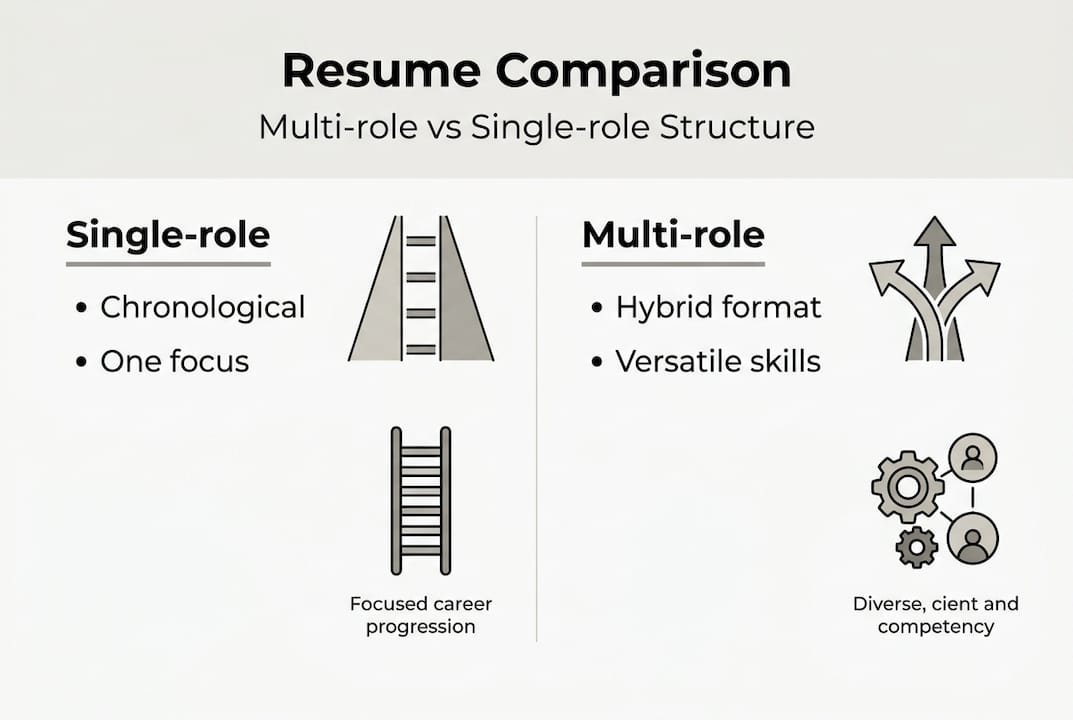
| Feature | Single-role resume | Multi-role resume |
|---|---|---|
| Structure | Chronological | Hybrid (chronological + functional) |
| Best for | One target job title | Multiple functions or industries |
| Skills section | Listed simply | Grouped by function or role type |
| Summary | Role-specific | Adaptable to target audience |
| ATS performance | High (if keyword-matched) | High (when tailored per application) |
| Risk | Too narrow for versatile candidates | Can appear scattered if poorly organized |
A single-role resume works best when your entire career points toward one clear goal. If you've spent ten years in supply chain logistics and you're applying for a senior logistics role, a tight chronological resume signals focus and commitment. That's a strength.

But if your background crosses functions, a single-role format can actually work against you. It either hides your most relevant skills or forces you to list everything without context. A combination format avoids making a work history appear scattered by using clear sections and relevant keywords that guide the reader's eye.
Here are the most common pitfalls with each approach:
- Single-role resume pitfall: Undersells transferable skills from adjacent roles
- Multi-role resume pitfall: Tries to include everything, resulting in a cluttered document
- Both formats: Fail without role-specific keyword optimization
The matrix resume template is particularly useful here because it gives you visual zones to separate role categories without creating confusion.
Pro Tip: To avoid looking indecisive, lead every version of your multi-role resume with a crisp, two-sentence professional summary that names a specific role. Recruiters want to know, immediately, what job you want. The rest of the resume then supports that claim with evidence from different angles.
How to build your multi-role resume: Key sections and tailoring tips
Recognizing the advantages of multi-role resumes, it's time to learn how to craft one for your unique career history.
The smartest approach is the core version method. Customizing a core resume version means starting from a base resume and then adjusting specific sections for each target role or skill set. You're not building five resumes from scratch. You're maintaining one strong foundation and making targeted edits.
Here are the steps to build yours:
- Write a flexible professional summary. Draft two to three versions, each aimed at a different role type. Swap in the relevant one for each application.
- Group your skills by function. Instead of one long list, organize skills under headers like "Operations," "Marketing," or "Product Development."
- Reorder your experience sections. Lead with the experience most relevant to the target role, even if it wasn't your most recent job.
- Inject ATS keywords. Mirror the exact language from each job posting in your skills and experience bullets.
- Quantify every key achievement. Numbers do the heavy lifting when words feel generic.
| Resume section | Core version content | Role-specific adjustment |
|---|---|---|
| Professional summary | Broad value statement | Tailored to target job title |
| Skills | Full skill inventory | Prioritized by role relevance |
| Work experience | All relevant roles | Reordered and reworded per job |
| Keywords | Industry-standard terms | Mirrored from job description |
Pro Tip: When applying through online portals, paste the job description into a free ATS checker before submitting. If your keyword match rate is below 70%, go back and update your summary and skills section. Templates like the brutalist resume template or the explorer resume template give you clean, structured layouts that make keyword placement natural rather than forced.
Real-world examples and success strategies
Once you've built a strong foundation, learn from real examples and discover strategies to set your resume apart.
Consider a professional who moved from marketing into operations. Her resume led with a summary highlighting her experience managing campaign budgets and vendor relationships, then connected that directly to operational planning. She didn't hide her marketing background. She reframed it as evidence of resource management and cross-team coordination. She landed interviews at three logistics companies within two weeks.
A second example: a software engineer transitioning into education technology. He led his resume with curriculum design projects he had contributed to voluntarily, then supported that with his technical background. His cross-functional hiring trends show recruiters are more interested in versatile candidates who can work across teams and adapt to new challenges. That framing helped him stand out in a field that traditionally hired only educators.
Here are advanced strategies that consistently work:
- Lead with impact. Start every bullet point with an action verb tied to a result, not a task.
- Use a callout statistic. One strong number, like "Increased cross-team project efficiency by 28%," does more work than three generic bullets.
- Cut the clutter. If a past role doesn't support the target position, summarize it in one line or leave it out.
- Create a keyword matrix. List the five most important terms from the job posting and make sure each one appears at least once in your resume.
Statistic callout: Resumes that include specific, quantified achievements are significantly more likely to progress past the first screening round. A result like "Reduced onboarding time by 35%" or "Managed a $400K annual budget" makes your value concrete and memorable.
The sketch resume template and the desert resume template both offer layouts that separate achievements visually, making it easy for recruiters to find your strongest results fast.
Why multi-role resumes are the future—what experts miss
Most career advice treats multi-role resumes as a problem to manage, a workaround for people who can't commit to a lane. That framing gets it completely wrong.
Modern work is hybrid by default. Companies run lean teams where one person might handle product research, stakeholder communication, and project execution simultaneously. A candidate who can only point to one narrow function is actually a risk, not a safe bet. Hiring managers increasingly want to see breadth alongside depth.
The uncomfortable truth is that most job seekers under-emphasize their flexibility because they've been told to "stay focused." That advice made sense in an era of rigid job descriptions. It doesn't reflect how teams actually operate in 2026.
The minimal format advantages are a good example of this shift: clean, spacious layouts that let multiple skill domains coexist without visual noise. The design signals capability, not confusion.
What experts miss is that a multi-role resume, done well, is not a compromise. It's a positioning strategy. It tells a coherent story about someone who has operated successfully in multiple contexts, which is exactly what growing companies need most.
Build your standout multi-role resume with Prezumi
Ready to put these insights into action? Here's how Prezumi can help you take the next step with your resume.
Prezumi is built for exactly this challenge. Whether you're targeting two industries or five different roles, the platform lets you customize from a single profile without rebuilding from scratch each time.
Start with a template designed for versatility, like the Minimal Resume Template, the Blueprint Resume Template, or the Metro Resume Template. Prezumi's AI-powered editor helps you tailor your summary, reorder sections, and optimize keywords for each application in under five minutes. No design experience needed. Just your experience, organized to win.
Frequently asked questions
What makes a resume 'multi-role'?
A multi-role resume highlights cross-functional experience by organizing skills and accomplishments from more than one role or industry. A hybrid resume format showcases cross-functional expertise by blending chronological history with skills-based grouping.
Do multi-role resumes work with Applicant Tracking Systems (ATS)?
Yes, when you tailor each section to the job description, a multi-role resume performs well with ATS software. Mirroring job-posting language and updating core sections significantly improves your match rate.
How do I know if I should use a multi-role resume?
If you've worked across different functions or industries and want to showcase a broad skill set, a multi-role format is often the best choice. Professionals with cross-functional experience benefit most from a hybrid format that positions their range as an asset.
What sections should be updated for each role?
Update your professional summary, skills list, and most relevant work experiences to align with each target job. Customizing role-specific sections ensures your resume stays relevant and keyword-matched to each unique job description.