

You could be the most qualified candidate in the applicant pool and still never hear back from a recruiter. That's because 75% of resumes are rejected by automated systems before a single human eyes them. Applicant Tracking Systems, or ATS, scan resumes for specific keywords, formatting signals, and job title matches. If your resume doesn't speak their language, it disappears. The good news is that resume tailoring is a learnable, repeatable skill. This guide walks you through exactly how to customize your resume for any role, beat the ATS filters, and land more interviews.
Table of Contents
- Why tailoring your resume matters
- Gather your tools and analyze the job posting
- Step-by-step instructions to tailor your resume
- Common mistakes and final checks for ATS success
- A fresh perspective on resume tailoring
- Create professional, ATS-friendly resumes in minutes
- Frequently asked questions
Key Takeaways
| Point | Details |
|---|---|
| ATS rejection is common | Most resumes never reach recruiters unless tailored for both humans and machines. |
| Tailoring raises callbacks | You can get 50% more callbacks just by aligning your resume with the job posting. |
| Use job-specific keywords | Adding 8 to 12 relevant keywords boosts your ATS score and application success. |
| Avoid generic mistakes | Common errors like keyword stuffing and irrelevant details can ruin your chances. |
| Balance automation and authenticity | Leverage AI tools but make sure your unique story is clear and compelling. |
Why tailoring your resume matters
Sending the same resume to every job posting feels efficient. It isn't. Hiring software doesn't reward effort or loyalty; it rewards precision. Most mid-size and large companies now use ATS to sort through hundreds of applications per role, automatically disqualifying resumes that don't match specific criteria. The result? Qualified applicants never get a fair shot.
The numbers are striking. Tailored resumes receive 50% more callbacks, and simply matching the job title on your resume to the one in the posting can increase your interview chances by up to 10.6 times. That's not a marginal improvement. That's the difference between silence and a scheduled call.
Here's a summary of the data that makes the case for tailoring:
| Metric | Value |
|---|---|
| Resumes rejected before human review | 75% |
| Increase in callbacks from tailored resumes | 50% more |
| Interview boost from job title match | Up to 10.6x |
| Average ATS score improvement with 8-12 keywords | +11.4 points |
| Median ATS score for unoptimized resumes | 62 out of 100 |
Think about that median score. Most resumes score a 62 out of 100 when run through ATS software. That's a failing grade in a competition where only the top performers advance.
"Even if you have every qualification a job requires, a poorly formatted or keyword-light resume can eliminate you before any human ever reads your name."
This is the core problem with the "spray and pray" approach to job applications. A generic resume optimized for nobody gets filtered out by everybody. The ATS-ready resume templates and the AI-powered resume editor on Prezumi were built precisely to solve this. Tailoring isn't optional anymore. It's your entry fee.
Gather your tools and analyze the job posting
Before you touch a single word of your resume, you need the right setup. Think of it like a contractor showing up to a job site. Without the right tools, even skilled workers can't do their best work.
Start with the job posting itself. Copy the full text into a plain document. This is your source material. From there, break it into three categories:
- Job title and headline terms: The exact language used to describe the role
- Core responsibilities: Tasks the employer expects you to handle daily
- Required skills: Non-negotiable qualifications listed explicitly
- Preferred experience: Nice-to-haves that strengthen your candidacy
- Company language: Phrases, values, and tone the employer uses consistently
This breakdown helps you speak the employer's language instead of your own. Most candidates write about their experience the way they think about it, not the way the recruiter is searching for it. That mismatch costs interviews.

Now compare your tools. You have two main options: manual editing or AI-powered assistance.
| Feature | Manual editing | AI-powered editing |
|---|---|---|
| Speed | Slow (1-3 hours per resume) | Fast (under 15 minutes) |
| Keyword accuracy | Depends on your analysis | Data-driven, precise |
| ATS optimization | Requires manual research | Built-in scoring and feedback |
| Formatting consistency | Varies by user skill | Template-controlled |
| Version management | Manual file saving | Organized within the platform |
Adding 8-12 targeted keywords from a job description can boost your ATS score by an average of 11.4 points. That's not guesswork. It's measurable. An AI resume and portfolio editor can surface those keywords automatically, saving you time and reducing errors.
Pro Tip: Save a clearly labeled copy of every tailored resume version (for example, "resume_marketing_manager_june2026"). This archive saves hours when you apply to similar roles later.
Step-by-step instructions to tailor your resume
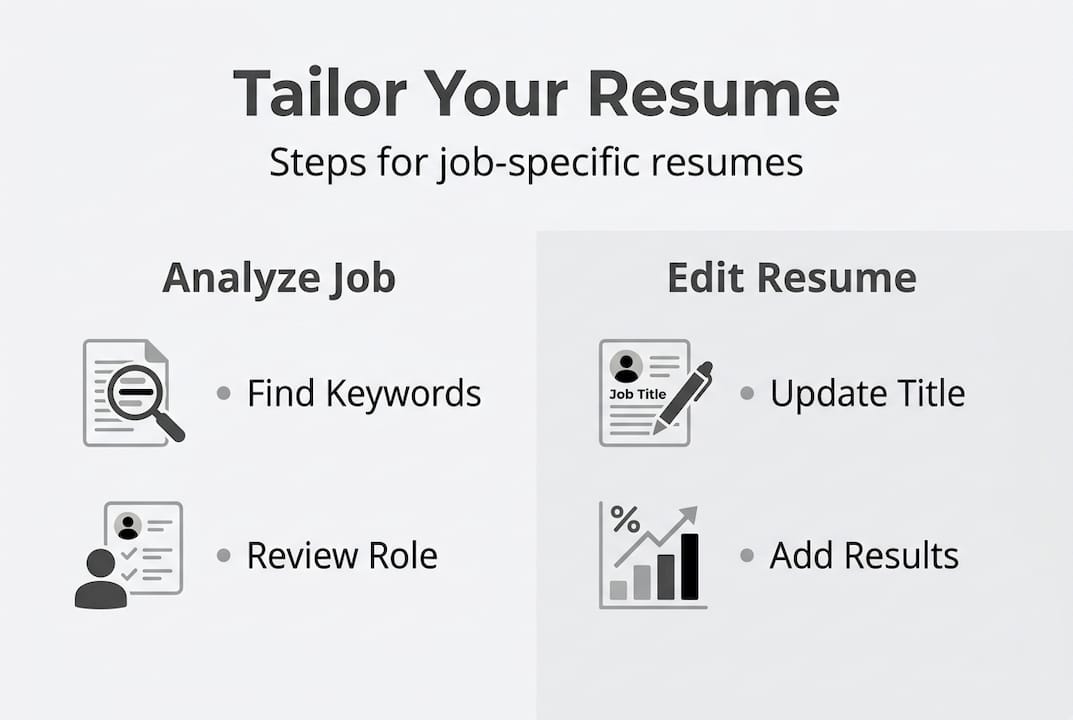
With your tools in place and your job posting broken down, you're ready to build a targeted resume. Follow this process consistently and you'll cut your ATS rejection rate significantly.
-
Copy the full job posting into a document. Highlight every skill, responsibility, and qualification mentioned. Pay special attention to words that appear more than once. Repetition signals priority.
-
Identify 8 to 12 priority keywords. Focus on technical skills, software names, certifications, and action-oriented phrases. These are the terms ATS algorithms weigh most heavily.
-
Rewrite your headline and summary first. This is the prime real estate of your resume. Match the exact job title if your experience supports it. Weave in two or three of your most important keywords naturally.
-
Update your work history bullet points. Rephrase responsibilities using the employer's language. Don't invent experience, but do mirror their terminology. "Managed social media campaigns" becomes "Led paid social media strategy across Instagram and LinkedIn" if those platforms are mentioned in the posting.
-
Refresh your skills section. Remove skills not relevant to this role. Add ones from the job description that you genuinely have but forgot to include.
-
Update metrics and achievements. Numbers matter. Quantified results are harder to ignore and easier for ATS to flag as strong signals.
Here's a quick before-and-after to make this concrete:
Before: "Helped with customer service and handled complaints." After: "Resolved 95% of customer escalations within 24 hours, improving satisfaction scores by 18%."
The second version is specific, measurable, and action-driven. Keyword mismatch causes 68% of ATS rejections, so precision here directly affects your results. If you need a structured format to work within, customizing a CV for roles is a strong starting point.
Pro Tip: Lead every bullet point with a strong action verb like "led," "built," "reduced," or "launched." Passive phrasing buries your impact.
Common mistakes and final checks for ATS success
Modifying your resume is only half the work. Reviewing it carefully before you submit is what separates polished candidates from those who self-sabotage at the finish line.
Mistakes that hurt your ATS score:
- Ignoring the job title. Not matching or closely mirroring the posted title is one of the most costly oversights.
- Keyword stuffing. Cramming in keywords unnaturally triggers spam filters in many ATS platforms. Write for humans first, algorithms second.
- Over-designing your resume. Graphics, tables inside text areas, headers and footers, and custom fonts often break ATS parsing. Keep it clean.
- Including irrelevant experience. Every line should earn its spot. Unrelated roles dilute your relevance score.
- Using images or icons. Most ATS software cannot read visual elements and may reject resumes that contain them.
A median resume scores 62 out of 100 on ATS scans. Your target should be 80 or above. At that threshold, your resume passes automated filters and reaches a recruiter with a strong foundation.
Before you hit submit, run through this checklist:
- Job title on your resume matches or closely mirrors the posting
- 8 to 12 relevant keywords are naturally integrated
- No graphics, icons, or images in the resume body
- Standard fonts only (Arial, Calibri, Times New Roman)
- Work history bullet points are specific and quantified
- Skills section reflects the role's requirements
- File is saved as a plain .docx or PDF without complex formatting
- No unexplained gaps or irrelevant roles cluttering the document
Pro Tip: Use a free or paid ATS simulator tool to score your resume before submission. Even a rough score gives you a benchmark to improve against. ATS-ready templates and resume optimization tools can speed up this final review significantly.
A fresh perspective on resume tailoring
Here's something the typical resume advice won't tell you: over-tailoring is a real problem. When every single word is engineered for an algorithm, the human reading your resume on the other side often senses it. The writing feels flat. The story disappears. You become a list of keywords, not a candidate.
The most effective approach we've seen isn't to tailor every resume to exhaustion. It's to identify a small group of roles that genuinely fit your experience and goals, then build deeply customized, authentic resumes for each. Quality over volume wins in competitive hiring.
AI tools and ATS optimization are powerful, but they're a means to an end. Your unique perspective, the specific way you solved problems and delivered results, is what makes a recruiter pause. Efficient resume tailoring with AI should amplify that story, not replace it. Use the data as a guide. Let your voice do the convincing.
Create professional, ATS-friendly resumes in minutes
Tailoring your resume doesn't have to mean hours of frustrating rewrites. Prezumi's AI resume templates are designed to help you build ATS-optimized resumes quickly, without sacrificing a professional finish. The platform's AI resume editor surfaces relevant keywords, suggests stronger phrasing, and keeps your formatting clean across every version you create.
Whether you're applying for your first role or pivoting into a new industry, the Minimal Resume Template gives you a polished, recruiter-ready starting point. Start tailoring smarter today and put your resume in front of the people who need to see it.
Frequently asked questions
What is an ATS and why does it matter for resumes?
An ATS, or applicant tracking system, is software that scans and filters resumes based on keywords, formatting, and job criteria. It matters because 75% of resumes are filtered out before any human reviews them.
How many keywords should I add to my resume?
Adding 8-12 relevant keywords from the job description is the sweet spot, raising your ATS score by an average of 11.4 points without triggering keyword stuffing filters.
How can I check if my resume will pass an ATS?
Use an online ATS simulator or an AI-powered resume editor to scan your resume and get a score before you submit. Aim for 80 out of 100 or higher for the best results.
Should I always match the job title on my resume to the job posting?
Yes, when your experience supports it. A title match can boost your interview chances by up to 10.6 times compared to resumes with mismatched titles.
Recommended
- AI Resume Templates — ATS-Ready, Built in Under 5 Minutes | Prezumi
- Europass-Style CV & Resume for European Jobs — AI-Powered | Prezumi
- Metro Resume Template — Prezumi
- Typewriter Resume Template — Prezumi
- How to Use AI Tools to Review Resume
- Job search strategy guide: Secure your next tech leadership role