

Most job seekers treat resume structure like interior decorating: something you tweak at the end to make things look neat. That's the wrong way to think about it. Structure is the foundation of your entire application strategy. It controls whether a recruiter's eye lands on your strongest selling points or drifts away after three seconds. It also determines whether automated screening software even passes your resume to a human. Poor resume structure can disqualify you before anyone reads a single word. This guide breaks down exactly what resume structure means, how it works for different career stages, and how to use it as a deliberate tool to get more interviews.
Table of Contents
- What is resume structure?
- Core sections of a great resume
- How section order changes by experience
- Beyond the basics: Customizing structure for your field or goals
- Why resume structure is more strategic than you think
- Build your perfect resume structure now
- Frequently asked questions
Key Takeaways
| Point | Details |
|---|---|
| Structure matters | Proper resume structure helps your application beat ATS and catch recruiters’ attention. |
| Section order shifts | Experienced professionals and recent grads should use different section orders for best results. |
| Customization is key | Adapting your structure for your field or unique work history makes your resume stand out. |
| No perfect formula | There’s no one-size-fits-all solution—strategic structure matches your goals and audience. |
What is resume structure?
Resume structure refers to the order and labeling of sections within your resume. It's not the font you choose or the color of your header. It's the sequence of information: what comes first, what comes second, and what gets left out entirely.
The purpose of structure is to guide the reader. Recruiters don't read resumes the way you'd read a novel. They scan. Research consistently shows that recruiters spend as little as 7 seconds on an initial resume review. That means your most relevant information needs to appear near the top, in a predictable location, with a clear label.
"Resume structure can determine whether your application makes it past ATS screening." Structure isn't just about aesthetics. It's about survival in a competitive hiring process.
ATS (Applicant Tracking System) software adds another layer of complexity. These tools parse your resume before a human ever sees it. They look for recognizable section headers like "Experience" or "Skills." If you label your experience section something creative like "My Journey," the ATS may not recognize it and could rank your application lower or skip it entirely.
Common structural mistakes include:
- Burying contact information below a long summary
- Using too many sections that dilute focus
- Placing education before experience when you have years of work history
- Skipping a skills section when applying to technical roles
- Using inconsistent formatting that confuses both ATS and human readers
The essential building blocks of a well-structured resume are: contact information, professional summary, skills, work experience, and education. Everything else is optional and should only appear when it genuinely strengthens your application for a specific role.

Core sections of a great resume
Let's break down what each core section should do and how to make it work harder for you.
- Contact information: Include your full name, phone number, professional email, LinkedIn URL, and city or region. You don't need your full mailing address. Keep it clean and scannable at the very top.
- Professional summary: Two to three sentences that position you for the specific role. Lead with your title or specialty, then mention your biggest measurable impact. Think of it as your elevator pitch in writing.
- Skills section: Separate hard skills (software, languages, certifications) from soft skills (communication, leadership). Hard skills are more ATS-friendly because they match job description keywords directly.
- Work experience: List roles in reverse-chronological order, meaning your most recent job comes first. Use strong action verbs and quantify your results wherever possible. "Increased email open rates by 34%" is far more compelling than "managed email campaigns."
- Education: Include your degree, institution, and graduation year. Recent graduates should also list relevant coursework, honors, or academic projects.
| Section | What it is | Why it matters |
|---|---|---|
| Contact info | Name, email, phone, location | Makes it easy for recruiters to reach you |
| Summary | 2-3 sentence positioning statement | Sets context and hooks the reader |
| Skills | Hard and soft skills list | Matches ATS keywords and shows fit |
| Experience | Reverse-chronological work history | Demonstrates proven results |
| Education | Degrees and credentials | Validates qualifications |
Optimal section order varies by career stage, which is why one-size-fits-all templates often fall short. If you want to see how a clean, well-ordered resume looks in practice, the Explorer resume example and the Minimalist layout are great references.
Pro Tip: Write your professional summary after you've completed the rest of your resume. You'll have a clearer picture of your strongest points and can write a more focused, confident statement.
How section order changes by experience
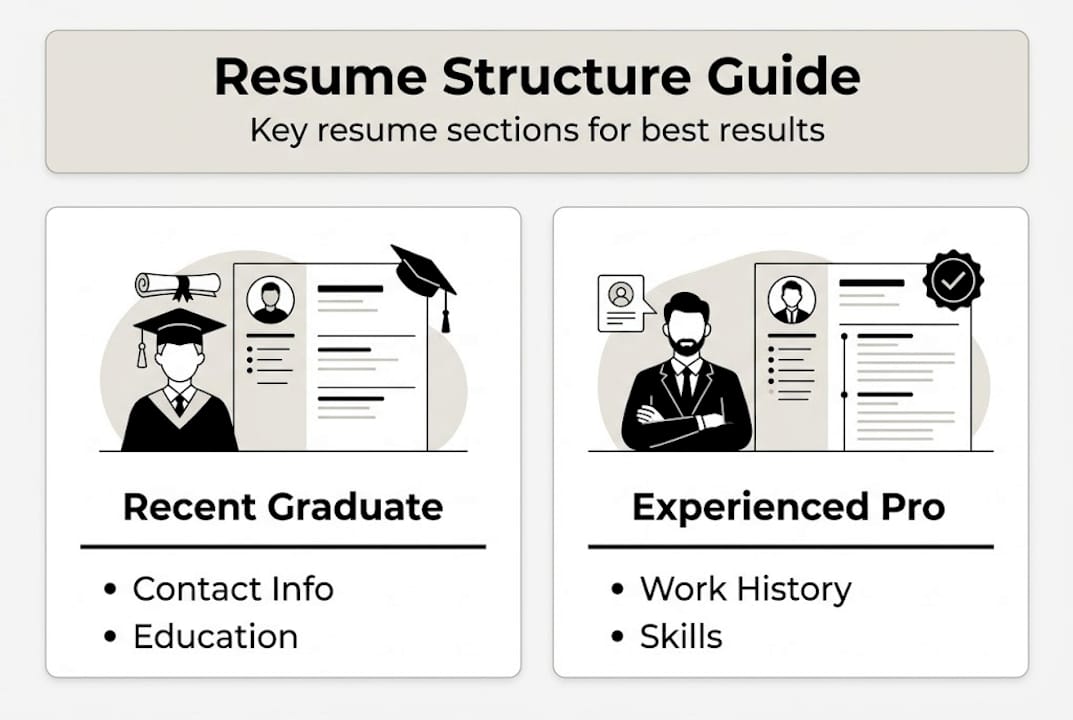
Experienced professionals and recent grads should use different section orders because what's most relevant to a recruiter changes entirely based on your background.
If you have five or more years of experience, your work history is your strongest asset. Lead with it. Recruiters want to see what you've done and where you've done it before they care about where you studied.
If you're a recent graduate, your degree is often your most credible credential. Place education near the top, right after your contact information and summary. Then follow with any internships, part-time roles, or relevant projects.
| Section order | Recent graduate | Experienced professional |
|---|---|---|
| 1 | Contact info | Contact info |
| 2 | Summary | Summary |
| 3 | Education | Work experience |
| 4 | Experience | Skills |
| 5 | Skills | Education |
Career pivots create a different challenge. If you're switching industries, you may want to lead with a strong skills section that emphasizes transferable abilities before diving into a work history that looks unrelated at first glance.
Freelancers face a similar situation. A traditional chronological structure can make a freelance career look scattered. Instead, grouping work by type of project or client outcome can tell a much cleaner story.
Common pitfalls by group:
- Recent graduates: Padding the resume with irrelevant high school details or listing GPA when it's not impressive
- Experienced professionals: Listing roles going back 20 years when only the last 10 are relevant
- Career changers: Failing to reframe past experience in language that fits the new industry
- Freelancers: Presenting work as a long list of one-off gigs without showing cumulative impact
Pro Tip: If you're unsure which structure fits your situation, look at the Blueprint template structure for a flexible format that adapts across career stages.
Beyond the basics: Customizing structure for your field or goals
Not every career fits neatly into the standard five-section format. Some fields and goals call for a different approach entirely.
Creative professionals like designers, photographers, and copywriters often benefit from adding a portfolio or projects section near the top. Showing work directly in the resume, or linking to it prominently, gives hiring managers immediate proof of ability that no bullet point can replicate.
Freelancers should generally prioritize their skills and portfolio before listing individual clients or contracts. The goal is to show what you can do, not just who you've worked for. Leading with capabilities makes your resume more compelling to clients who don't recognize your previous clients' names.
Academic resumes may prioritize education and leadership, while private sector resumes are structured to hit ATS keyword targets and demonstrate measurable output. These are genuinely different documents with different goals, even if they're written by the same person.
Alternate section types worth considering:
- Projects: Ideal for developers, designers, and students with limited work experience
- Publications: Essential for academics, journalists, and researchers
- Certifications: High value in tech, healthcare, finance, and legal fields
- Awards and recognition: Useful when they're industry-specific and recent
- Volunteer work: Relevant when it demonstrates leadership or skills that paid roles don't cover
For bold, field-specific formats, the Brutalist resume style and the Tech/IT format example show how structure can be adapted without sacrificing professionalism.
Pro Tip: Before finalizing your structure, read the job description three times. Note which skills and qualifications appear first. Mirror that priority order in your resume sections. You're not just matching keywords. You're matching the employer's mental model of the ideal candidate.
Why resume structure is more strategic than you think
Here's something most resume guides won't tell you: there is no universally perfect resume structure. There are only structures that work for your specific situation, your target role, and your career story.
Think of your resume as a personal marketing funnel. Every section is a filter. The goal is to move the recruiter from "who is this person?" to "I need to talk to them" as fast as possible. That's not a formatting exercise. It's strategic communication.
Real hiring managers scan for relevance in seconds, not minutes. They're not reading your resume. They're looking for a reason to keep reading. Structure is what creates that reason. When your most relevant experience or skill appears in the first third of the page, you give the recruiter permission to invest more time.
The candidates who get the most callbacks aren't always the most qualified. They're the ones whose resumes tell the clearest, most relevant story in the least amount of time. Structure is how you control that story. Treat it like a deliberate choice, not a default template.
Build your perfect resume structure now
You now have a clear picture of how resume structure works and why it matters more than most people realize. The next step is putting it into practice without spending hours wrestling with formatting tools.
Prezumi gives you ready-to-use, professionally structured templates built for real hiring conditions. The Minimal resume template is perfect for clean, ATS-friendly layouts, while the Blueprint resume template offers a flexible structure that adapts to any career stage. If you want AI to handle the heavy lifting, the Prezumi AI resume builder generates a polished, structured resume in under five minutes. Pick a template, customize it for your goals, and start applying with confidence.
Frequently asked questions
What are the main parts of a resume structure?
The main parts are contact information, a professional summary, skills, work experience, and education. These five sections form the core of any effective resume.
Does the resume section order really matter?
Yes. Section order impacts ATS ranking and recruiter attention, so placing your strongest qualifications near the top significantly improves your chances of moving forward.
How should a recent graduate structure a resume?
Recent graduates should lead with contact information and education, then follow with experience and a skills section tailored to the target role.
Can freelancers or creatives use a different resume structure?
Absolutely. Customized structures for creative portfolios and non-traditional careers work well when you lead with skills, projects, or portfolio links before listing individual clients or contracts.
What is the difference between resume structure and format?
Structure refers to the order and selection of sections, while format covers visual elements like fonts, spacing, and layout design. Both matter, but structure affects ATS performance more directly.