

Recruiters spend an average of 47 seconds reviewing a portfolio before deciding whether to move forward. That's not much time to make an impression. Yet most students, freelancers, and professionals submit portfolios that are cluttered, vague, or completely mismatched to their audience. The result? Ignored, archived, forgotten. This guide cuts through the noise with a step-by-step framework built for people who need results fast. Whether you're landing your first client, applying to a dream job, or pitching a new project, what follows will help you build a portfolio that actually gets noticed.
Table of Contents
- What you need before you start: Tools, assets, and requirements
- Step-by-step structure: Building your portfolio for results
- Storytelling and customization: Connecting with your audience
- Expert polish: Finishing touches and interview readiness
- The overlooked truth: Why most portfolios fail (and how to avoid it)
- Build a standout portfolio in minutes with Prezumi
- Frequently asked questions
Key Takeaways
| Point | Details |
|---|---|
| Curate high-impact projects | Select 3-5 relevant, results-oriented works for maximum attention. |
| Leverage storytelling frameworks | Use PSR or STAR to clearly communicate your process and achievements. |
| Tailor for your audience | Customize project choice and narrative for students, freelancers, or business roles. |
| Optimize for digital review | Prioritize mobile-friendly design, scannability, and shareable links. |
| Update and rehearse quarterly | Keep content current and practice delivering your portfolio for interviews or presentations. |
What you need before you start: Tools, assets, and requirements
Before you dive into structuring or storytelling, ensure you have all the essentials ready. Jumping straight into design without the right materials is one of the most common mistakes people make, and it leads to portfolios that feel rushed or incomplete.
Start by collecting 3 to 5 high-impact projects. If you're a student or career changer without client work, use academic projects, spec work, or volunteer contributions. What matters is showing a process and an outcome, not just a finished product.
Next, gather your assets:
- Project screenshots, mockups, or visuals
- Case study notes organized using the PSR (Problem, Solution, Results) or STAR (Situation, Task, Action, Result) framework
- Testimonials or written approvals, even informal ones from professors or collaborators
- Quantified results wherever possible (traffic growth, grades, revenue, time saved)
For tools, you'll need a digital presentation platform, access to business portfolio best practices, and a way to test your portfolio on mobile. This last point matters more than most people realize: over 60% of portfolio reviews happen on a mobile device, so digital formats are strongly preferred over printed binders.
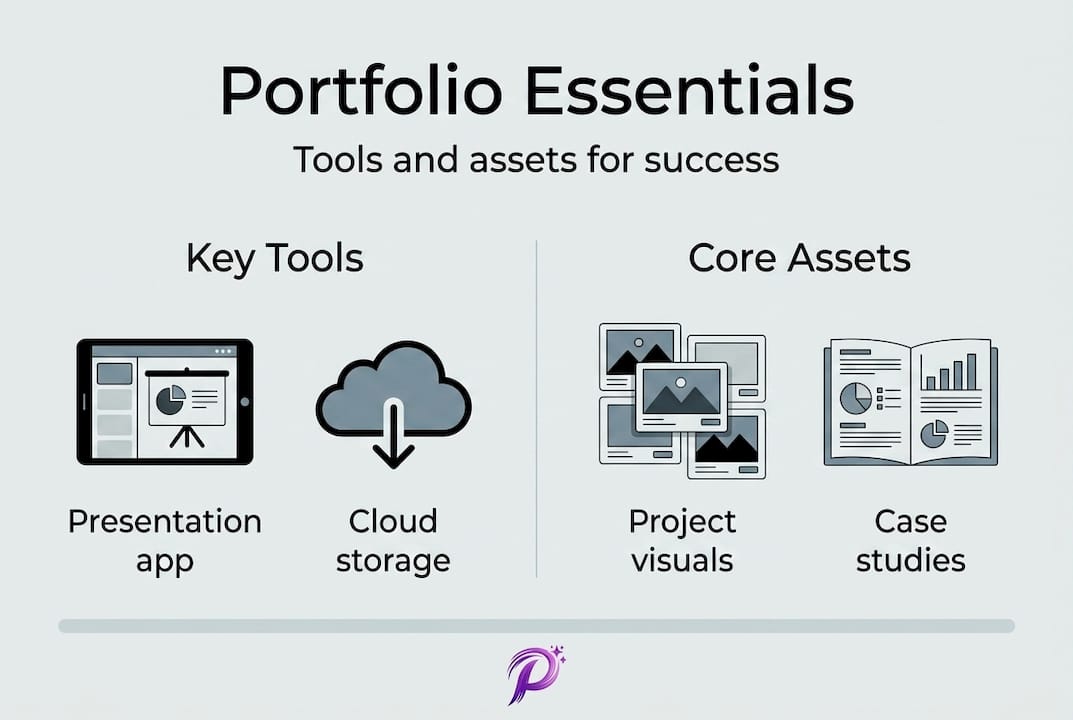
| Asset type | Why it matters | What to prepare |
|---|---|---|
| Project visuals | First impression driver | Screenshots, mockups, photos |
| Case study notes | Proves your thinking | PSR or STAR formatted notes |
| Testimonials | Builds trust fast | Quotes, emails, approvals |
| Metrics | Shows real impact | Numbers, percentages, timelines |
| Shareable links | Enables digital delivery | Cloud links, URLs |
Also think about portability. Cloud hosting and shareable portfolio links make it easy to send your work in seconds during a job application or client pitch. If you're dealing with NDA restrictions on certain projects, describe your process and role without revealing confidential details. Lack of metrics is not a dealbreaker either. You can use qualitative wins instead.
Templates like the Particles portfolio template are designed to accommodate all of these asset types cleanly, so your content shines without requiring any design skills.
Pro Tip: Create a single master folder with all your project assets, notes, and links before opening any design tool. This alone cuts your build time in half.
Step-by-step structure: Building your portfolio for results
Once your assets and tools are ready, it's time to build your portfolio using strategies that maximize attention and results. A well-structured portfolio isn't just organized, it's engineered to move the reader through a story that ends with them wanting to work with you.

The ideal portfolio follows this sequence: a strong introduction, curated case studies, clear results and learnings, and a focused call to action. Research shows that targeted intros and case studies boost interview rates by 45%, which means structure is directly tied to outcomes.
Here's a proven 10-step flow for each case study:
- Intro — Who you are and what this project represents
- Favorite project — Lead with your best work
- Your role — Clarify what you personally contributed
- The challenge — Define the problem clearly
- Your process — Show how you think, not just what you did
- The solution — What you built or delivered
- Key decisions — Explain the choices that shaped the outcome
- Results — Use numbers whenever possible
- Learnings — Shows growth and self-awareness
- Call to action — Make it easy to contact or hire you
When it comes to case study frameworks, PSR and STAR each have strengths. PSR and STAR frameworks are the core mechanics for building portfolio case studies that resonate with both human reviewers and automated systems.
| Framework | Best for | Focus |
|---|---|---|
| PSR (Problem, Solution, Results) | Freelancers, creatives | Outcome-first storytelling |
| STAR (Situation, Task, Action, Result) | Professionals, job seekers | Process and impact clarity |
For students, emphasize progression and learning. For freelancers, lead with client results. For professionals, align every section with business outcomes and ATS keywords. Templates like the Chalkboard portfolio structure and the Blueprint portfolio template offer pre-built layouts for each of these audiences.
Pro Tip: Always place your single strongest project first. Reviewers rarely make it to the end, so your best work needs to land in the first scroll.
Storytelling and customization: Connecting with your audience
Structure alone isn't enough. Customizing the narrative for your industry and audience unlocks the real value. A portfolio that talks to everyone ends up resonating with no one.
Storytelling is what separates a portfolio that gets bookmarked from one that gets closed. Context makes your work understandable. Without it, even impressive results can feel meaningless to someone who doesn't know your field.
Here's how to tailor your portfolio by audience:
- Students: Highlight academic progression, course projects, and skills developed. Show a growth arc from early attempts to polished work.
- Freelancers: Focus on niche, client names or industries, and measurable results. Reviewers want to know you've done this before and can do it again. Freelancer portfolio techniques are built around exactly this kind of result-first structure.
- Professionals: Center on business impact, leadership moments, and ATS-friendly language. Use industry keywords naturally so both human reviewers and algorithms can find your strengths.
As the freelancer portfolio guide notes, the key is to tailor structure and examples to your specific audience: progression for students, results for freelancers, and ATS optimization and business goals for professionals.
"Your portfolio isn't a scrapbook of everything you've done. It's a curated argument for why you're the right person for this specific opportunity."
If you don't have metrics, use qualitative wins. A professor's commendation, a client's repeat booking, or a team lead's written approval all carry weight. Visuals matter too. Use clean layouts, scannable headings, and whitespace so reviewers can absorb your story in seconds. External resources like freelance portfolio creation tips offer solid guidance on visual hierarchy and client-first framing. The Europass portfolio example is also worth reviewing for its clean, professional formatting approach.
Expert polish: Finishing touches and interview readiness
Now that customization is in place, fine-tuning your portfolio and prepping for live delivery sets you apart from everyone else who just hits send and waits.
Start with a digital polish checklist:
- Confirm ATS compatibility: no text embedded in images, proper heading hierarchy
- Test on at least two mobile devices before sending
- Use cloud delivery with a clean, shareable URL (see shareable resume techniques for how to set this up right)
- Add interactive elements like clickable project thumbnails or embedded videos where appropriate
- Remove any project that doesn't directly support the role or client you're targeting
Key stat: AI screens 78% of profiles before a human ever sees them, and portfolios with well-documented metrics are 2.8x more likely to win clients. That means optimization isn't optional.
For interview prep, rehearse each case study in 5 to 7 minutes. Practice answering follow-up questions like "What would you do differently?" or "How did the client react?" This is where candidates consistently lose points. They built a great portfolio but can't speak fluently to the work inside it.
Update your portfolio every quarter. Add recent results, swap out weaker projects, and refresh your bio to reflect your current goals. Stale portfolios signal stagnation, even when your skills are growing. The map portfolio design makes quarterly updates straightforward with modular sections you can swap in minutes.
Pro Tip: Record yourself walking through one case study on your phone. Watch it back. If you stumble or rush past the results, that's exactly what will happen in the real interview.
Common mistakes to avoid: overdesigning with animations that distract, including irrelevant projects just to fill space, and skipping mobile testing entirely.
The overlooked truth: Why most portfolios fail (and how to avoid it)
After perfecting the process, let's step back and address a myth: simply following a template is enough. It isn't.
Most portfolios fail not because they look bad, but because they're unclear. The results are buried. The audience is undefined. The story assumes the reader already cares, which they don't, not yet.
Here's what we've seen consistently: overdesigned portfolios with custom animations and elaborate color schemes get dismissed faster than clean, simple ones. Why? Because visual complexity creates cognitive friction. When a recruiter or client has to work to understand what you did and what happened because of it, they stop reading.
ATS systems and AI screening tools are even more ruthless. They aren't impressed by beautiful layouts. They're looking for keyword density, clear role titles, and quantified outcomes. An infographic portfolio clarity approach that balances visual appeal with structured, readable text consistently outperforms purely decorative designs.
The portfolios that win are minimal, scannable, and results-first. They make the reviewer's job easy. Every section answers one question: "So what?" If your portfolio can't answer that question within the first 30 seconds of scrolling, it needs to be restructured, not redesigned.
Build a standout portfolio in minutes with Prezumi
Ready to put these insights to work? Streamline your next presentation with powerful, ready-made tools.
Prezumi is built for exactly this kind of fast, focused portfolio creation. You can go from blank page to a polished, recruiter-ready profile in under five minutes using templates designed for students, freelancers, and professionals. No design skills needed.
Explore options like the Matrix portfolio template for a bold, modern look, or the Minimal resume template if you want clean and ATS-friendly. Each template is mobile-optimized, shareable with a single link, and built to support the frameworks covered in this guide. Try Prezumi today and see how quickly a well-structured portfolio can change your results.
Frequently asked questions
What are the best frameworks for structuring portfolio case studies?
Use the Problem-Solution-Results (PSR) or STAR (Situation-Task-Action-Result) frameworks. Both are designed for clear, compelling storytelling that works for human reviewers and ATS systems alike.
How many projects should I include in my portfolio?
Stick to 3 to 5 strong projects that are directly relevant to your target role or client. Quality and relevance always outperform volume.
Do I need metrics if I'm just starting out or have only academic work?
No. When hard numbers aren't available, use qualitative wins such as approvals gained, positive feedback received, or demonstrated progression from one project to the next.
What's the top mistake to avoid in portfolio presentations?
Avoid stuffing your portfolio with irrelevant projects. Prioritize scannability and result-focused stories, and always test for mobile-first responsiveness since over 60% of reviews happen on mobile devices.
How do I update and maintain my portfolio for ongoing success?
Refresh it every quarter with new results, updated project outcomes, or stronger work. Quarterly portfolio updates keep your profile competitive and signal that you're actively growing in your field.