

Most job seekers assume adding a portfolio link to every application is a smart move. More proof of your work means more chances of getting noticed, right? Wrong. Embedding portfolio URLs actually reduces screening responses by 37% when used without strategy, often because recruiters land on slow, inaccessible sites or face a jarring context switch mid-review. The goal of this article is to show you exactly when portfolio links help, when they hurt, and how to present your work in a way that genuinely impresses hiring managers and potential clients.
Table of Contents
- Why portfolio links matter (and when they hurt)
- Evidence vs. links: What recruiters really want
- How to curate and present your portfolio for maximum impact
- Ensuring your portfolio links work for—not against—you
- Our perspective: Quality and context always win
- Ready to showcase your best work? Try these templates
- Frequently asked questions
Key Takeaways
| Point | Details |
|---|---|
| Embedded evidence wins | Providing work samples directly in your application leads to higher response rates and credibility. |
| Link quality matters | Only use portfolio links when they are requested or essential, and ensure they are fast and accessible. |
| Curate relevant samples | Select 3-5 examples using problem-solution-result storytelling to showcase your skills effectively. |
| Technical standards are critical | Portfolio sites must load quickly and comply with accessibility benchmarks to support your application. |
| Context beats quantity | Tailoring your portfolio to the job and embedding evidence outperforms generic link sharing every time. |
Why portfolio links matter (and when they hurt)
A portfolio is your professional proof. For freelancers especially, it bridges the gap between what your resume claims and what you can actually deliver. A strong portfolio tells a hiring manager, "Here is the real result, not just the job title." It adds weight to your application in a way that even the most polished resume cannot replicate on its own.
But here is the uncomfortable reality: simply slapping a URL into your application does not guarantee credibility. In fact, it can actively undermine you. When a recruiter has to stop reading your application, open a new tab, wait for a page to load, and then mentally reconnect with your candidacy, you have introduced friction. Every second of that friction is a chance for your momentum to collapse.
"Embedding portfolio URLs reduces screening responses by 37%. Recruiters prefer embedded samples over links because the context switch and poor site quality interrupt the review process." Source
The data behind this is striking. Two of the biggest culprits for failed portfolio links are accessibility and performance:
- 68% of portfolio sites fail basic accessibility standards, meaning screen readers, color contrast settings, and keyboard navigation often do not work correctly.
- 41% of portfolio sites load slowly, causing recruiters to abandon the page before it even finishes rendering.
- Many portfolio sites are built with outdated templates that look fine on desktop but break completely on mobile, where a growing share of recruitment screening happens.
- A site that looks impressive to you may appear cluttered, confusing, or unprofessional to a recruiter reviewing 80 applications in a single afternoon.
This does not mean you should never share your work online. Far from it. Using shareable portfolio links that are fast, accessible, and purpose-built for professional review is a different story entirely. The key distinction is quality and intent, not just the presence of a link.
Think of your portfolio the same way a skilled photographer thinks about a print versus a shared phone screen. The content may be identical, but the presentation affects how it is received. Strong personal branding tips consistently emphasize that the medium shapes the message. When your portfolio link points to a broken or slow page, it is not just a technical failure. It is a credibility signal going in the wrong direction.
So when should you include a portfolio link? Use links only when you genuinely need to demonstrate something that cannot be captured in a static embed, such as an interactive web app, a video reel, or a live design prototype. Even then, always ensure the link passes technical standards before you share it.
Evidence vs. links: What recruiters really want
Now that you know the risks and benefits, let us clarify what hiring managers actually value when reviewing portfolios. The short answer is this: recruiters want evidence, and they want it without effort. They are not interested in navigating your personal website. They want to see your best work right there, in context, without leaving the document or platform where they are already reviewing your application.
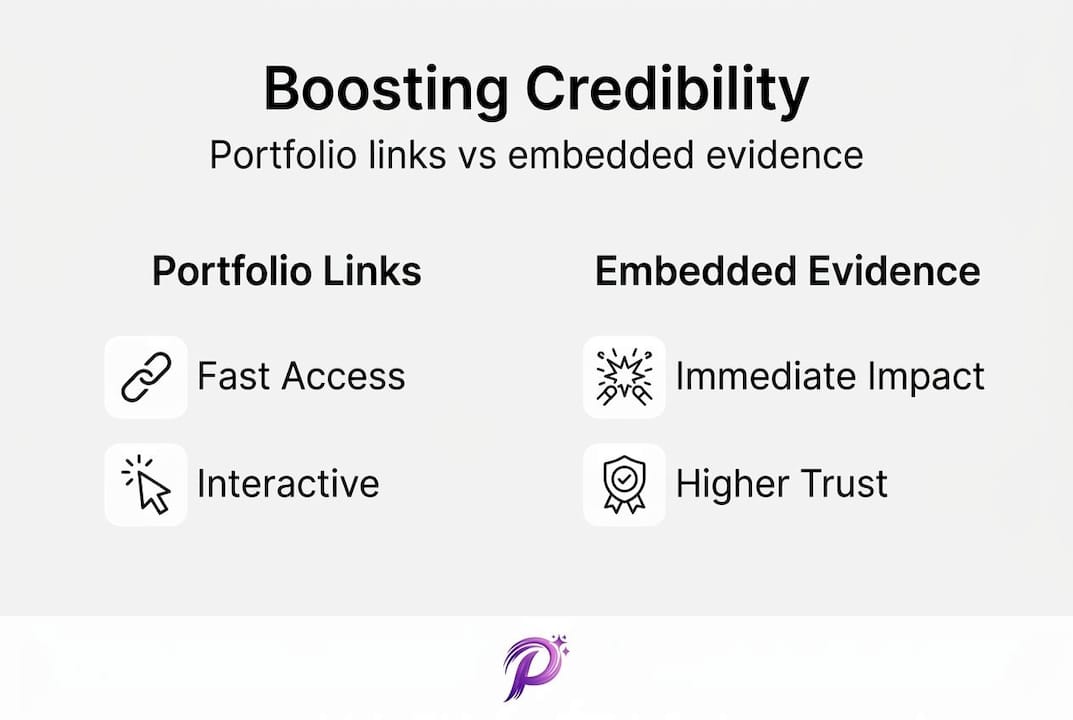
Research consistently shows that embedded samples perform better than external links, and the reasoning is simple. An embedded sample keeps the recruiter inside the flow of your application. They do not need to open a new tab, authenticate a platform, or wait for assets to load. The work is right there, paired with the context that makes it meaningful.
Here is a comparison to help you understand when each approach makes sense:
| Situation | Best approach | Why |
|---|---|---|
| Writing samples, case studies | Embed as PDF or inline text | Keeps the reviewer in context |
| Interactive web app or prototype | Link (if fast and accessible) | Static embed loses the experience |
| Video showreel or demo | Embed via thumbnail with link | Reduces friction, previews content |
| Graphic design or photography | Embed images or PDF | Avoids slow external gallery sites |
| Code repositories | Link to GitHub (it loads fast) | Platform is already recruiter-friendly |
Only link when the experience is truly irreplaceable. An AI portfolio editor can help you build sections where embedded samples sit naturally alongside your credentials, so the reviewer never loses momentum.
Pro Tip: Before sharing any portfolio link, run it through Google Lighthouse, a free browser tool that scores your site on performance and accessibility. Aim for a perfect 100/100 accessibility score and a load time under 1.2 seconds. If your site does not meet these thresholds, embed the evidence directly instead.
Here is a practical framework for deciding between links and embeds:
- Ask whether it was requested. If the job posting explicitly asks for a portfolio link, provide one. If it does not, default to embedding.
- Ask whether it is interactive. If the sample only makes sense when someone can click, scroll, or interact with it, a link may be necessary.
- Ask whether it is irreplaceable. If a PDF screenshot conveys the same value, use that instead.
- Ask whether it passes technical standards. If your site loads in over 1.5 seconds or fails accessibility checks, do not send the link.
Following these four steps consistently will put you ahead of the vast majority of applicants who share links without any strategic thought. Knowing more about building a digital marketing portfolio can also help you understand how seasoned professionals approach sample selection and presentation in competitive fields.
How to curate and present your portfolio for maximum impact
Having understood what recruiters want, here is how to choose and showcase examples to truly stand out. The biggest mistake most applicants make is showing too much. A portfolio with 20 mediocre samples is far weaker than one with four exceptional, well-contextualized pieces.

The industry standard used by top freelancers on platforms like Upwork follows a clear rule: curate 3 to 5 relevant pieces for each application, framing each one with a problem, solution, and result structure. This approach transforms a passive gallery into an active argument for your hiring. Instead of asking the recruiter to form their own conclusions, you guide them directly to the insight you want them to reach.
Consider the difference between these two portfolio entries for a content strategist:
Weak version: "Blog post written for SaaS company."
Strong version: "A B2B SaaS client was struggling with low organic traffic despite high ad spend. I audited their content strategy, identified 12 high-intent keyword gaps, and created a six-post content series targeting each gap. Within 90 days, organic traffic increased by 54% and lead form completions rose by 28%."
The second version gives the recruiter a story. It shows thinking, execution, and measurable outcome. That is what problem-solution-result storytelling delivers, and it works whether you are a designer, developer, writer, videographer, or data analyst.
Here is a checklist for curating your portfolio samples effectively:
- Relevance first. Choose samples that mirror the type of work in the job description. If the role involves social media campaigns, do not lead with your print advertising work.
- Recency matters. Samples from the last 2 to 3 years carry more weight than older work, unless an older piece is genuinely exceptional.
- Diversity within relevance. Show range within a specific skill set rather than scattering across completely different industries.
- Attach to proposals whenever possible. On freelance platforms, attaching samples directly to your proposal is more effective than linking externally, because the client reviews everything in one place.
- Tailor every time. Your master portfolio may contain 20 pieces, but each application should only receive the 3 to 5 most relevant ones.
Pro Tip: Think of your portfolio as a curated argument, not a personal archive. Every sample you include should answer the question, "Why does this piece prove I can do this specific job?" If you cannot answer that cleanly, the sample does not belong in this application.
Platforms built specifically for freelancers, like the portfolio for freelancers tools available through Prezumi, let you create multiple tailored versions from a single master profile. You can also experiment with presentation styles using a brutalist portfolio template if your industry responds well to bold, distinctive visual formats. Studying videography portfolio examples can be especially useful for anyone in creative fields who needs to balance visual storytelling with concise, structured presentation.
Ensuring your portfolio links work for—not against—you
Selecting the right samples is not enough. You also need to ensure your links actually deliver value when someone clicks them. A broken, slow, or inaccessible portfolio site can erase all the goodwill your resume and cover letter built in seconds.
Let us revisit the core technical data:
| Standard | Threshold | Why it matters |
|---|---|---|
| Page load time | Under 1.2 seconds | Slow pages get abandoned before content loads |
| Accessibility score | 100/100 (Google Lighthouse) | Failing sites block users and signal carelessness |
| Mobile responsiveness | Full functionality on mobile | Recruiters increasingly review on phones |
| HTTPS security | Required | Unsecured sites trigger browser warnings |
| Broken links | Zero | A 404 page tells the recruiter you are not detail-oriented |
The numbers make this urgent: 68% of portfolio sites fail accessibility standards, and 41% load too slowly to retain a recruiter's attention. These are not edge cases. They represent the majority of portfolio sites currently in use by job seekers who believe their content is the only thing being judged.
Here is a practical checklist before sharing any portfolio link:
- Run your site through Google Lighthouse and screenshot your scores.
- Test the link on both a desktop browser and a mobile device using a 4G connection, not your office WiFi.
- Click every internal link and ensure no 404 errors appear.
- Verify that all images load correctly and are not blurry or stretched.
- Check that your site uses HTTPS, not HTTP.
- Confirm the site works without requiring login, registration, or special software.
If your current portfolio site does not pass these checks, the smartest short-term move is to embed your samples directly into your application rather than link to a site that will create a negative impression. The shareable links feature from Prezumi is built around these technical standards, generating fast, accessible profile links without requiring you to manage hosting, performance, or code.
Your portfolio link is not just a URL. It is a representation of how thorough, detail-oriented, and professional you are. A recruiter who finds a slow, inaccessible site will unconsciously transfer that impression to your candidacy, even if your actual work is outstanding.
Our perspective: Quality and context always win
Taking all this evidence into account, here is a perspective you may not hear from most career coaches: the conventional advice to always include your portfolio link is not just outdated, it is actively harmful for many applicants.
Career advice tends to treat portfolio links as universally good, a signal of initiative and transparency. But what the data actually shows is that a low-quality portfolio link communicates the opposite. It tells the recruiter that you are either unaware of how your site performs, or that you do not care enough to check before sharing.
We have seen this pattern consistently when reviewing applications across industries. The strongest applications we encounter are not the ones with the most links. They are the ones where every piece of evidence is tightly curated, contextually relevant, and technically sound. A single embedded case study with a clear problem-solution-result narrative outperforms five external links to a cluttered portfolio website every single time.
The deeper lesson here is about knowing your audience. Recruiters and clients are not browsing your portfolio for fun. They are assessing your fitness for a specific role in under 30 seconds. Your job is to make that assessment as easy and favorable as possible, and that means removing friction, not adding it.
The path forward is not more links. It is smarter presentation. If you want to build a freelancer portfolio advice approach that actually converts applications into opportunities, start with fewer samples, better stories, and airtight technical standards. That combination wins.
Ready to showcase your best work? Try these templates
If you are ready to put these best practices into action, here are resources to make your application truly stand out. Prezumi gives you AI-powered tools that take the guesswork out of portfolio presentation, so you can focus on the work itself rather than the formatting.
Start with the blueprint portfolio template to build a clean, recruiter-optimized profile in minutes. Use the AI portfolio editor to craft compelling problem-solution-result narratives around each sample, with keyword suggestions to help your profile pass ATS filters. Every profile you create is mobile-compatible, fast-loading, and built for sharing with a single link that actually works. Stop guessing what recruiters want and start giving them exactly that.
Frequently asked questions
What makes a portfolio link acceptable in a job application?
A portfolio link is acceptable only when it is requested by the employer, when the sample is truly interactive or irreplaceable in link format, and when the site passes load and accessibility thresholds. Otherwise, embed your evidence directly.
How many samples should I include from my portfolio?
Curate 3 to 5 samples that are highly relevant to the specific role or client, and frame each one using a problem, solution, and result structure for maximum clarity and impact.
Do portfolio links increase my chances of getting hired?
Portfolio links can help when used strategically, but if implemented poorly, they reduce screening responses by 37%. Always prioritize context, technical quality, and relevance over simply adding a URL.
How do I test my portfolio for accessibility and performance?
Use Google Lighthouse, a free tool built into the Chrome browser, and aim for a 100/100 accessibility score and a load time under 1.2 seconds before sharing any portfolio link with an employer or client.