

Getting your resume past the first filter is harder than ever. Recruiters spend an average of seven seconds scanning a resume before deciding its fate, and most applications never even reach human eyes because automated systems screen them out first. The good news? Small, deliberate changes to how you write and structure your resume can produce outsized results. This article walks you through 10 evidence-backed strategies covering ATS optimization, skill presentation, achievement framing, gap handling, and formatting polish so you can compete with confidence in a crowded job market.
Table of Contents
- Optimize for ATS and recruiter appeal
- Highlight relevant hard and soft skills
- Showcase achievements with quantifiable impact
- Address gaps and career changes strategically
- Polish clarity, formatting, and error-proofing
- The truth about resume improvement: What really works
- Take the next step: Tools to accelerate your resume success
- Frequently asked questions
Key Takeaways
| Point | Details |
|---|---|
| ATS optimization basics | Match keywords from the job description to boost resume visibility and fit scores. |
| Soft skills stand out | Highlight your emotional intelligence and learning agility with concrete examples using the STAR method. |
| Quantify your impact | Use numbers—like metrics or results—to make achievements memorable and credible. |
| Address gaps head-on | Acknowledge career changes or gaps, emphasize transferable skills, and add credentials to reinforce your value. |
| Proofreading matters | Carefully check your resume for typos and formatting issues to signal professionalism and attention to detail. |
Optimize for ATS and recruiter appeal
An ATS (Applicant Tracking System) is software that scans resumes before a human ever sees them. These systems filter applications based on keyword matches, formatting compatibility, and relevance to the job description. Getting past the ATS is step one. But here is the catch: optimizing only for the machine can hurt you with the human reviewer.
Research confirms that tailoring resumes to specific job descriptions by incorporating keywords from the posting significantly improves your chances of clearing ATS filters. At the same time, a content-first approach matters because while ATS systems reject roughly 75% of applications before human review, over-optimized resumes stuffed with generic phrases often fail the recruiter stage anyway.
Here are three quick steps to strike the right balance:
- Mirror the job posting: Identify 5 to 8 keywords from the job description and weave them naturally into your bullet points and summary.
- Use standard formatting: Avoid tables, text boxes, or unusual fonts that ATS software cannot parse correctly.
- Keep it human-readable: Every bullet point should make sense to a person, not just a machine.
| Metric | ATS-optimized resumes | Recruiter-preferred resumes |
|---|---|---|
| Pass rate through ATS | High (75%+ cleared) | Moderate |
| Recruiter engagement | Low if over-optimized | High |
| Interview conversion | Low | High |
"A resume crammed with keywords but lacking authentic voice and relevant context will pass the bot and lose the human. Both audiences matter." — Career strategist perspective on AI-era hiring
Pro Tip: Avoid buzzword stuffing. If you list "synergy" or "results-driven" without evidence, recruiters will notice. Use AI resume templates to structure your content so it reads naturally while hitting the right keywords.
Highlight relevant hard and soft skills
Once ATS optimization is set, emphasizing your actual strengths is the next critical step. Hard skills are technical abilities you can measure, like coding, data analysis, or graphic design. Soft skills are interpersonal and behavioral traits like communication, adaptability, and leadership. Both matter, but the balance is shifting.
Employers increasingly value soft skills because technical roles are automating faster than human judgment can be replicated. Soft skills like learning agility and emotional intelligence, when proven through your work history using the STAR method, genuinely differentiate candidates from equally qualified competitors.
The STAR method stands for Situation, Task, Action, Result. Use it to frame soft skills as real stories rather than empty claims. Here is how to apply it:
- Identify a relevant soft skill from the job description (e.g., conflict resolution).
- Pick a real scenario from your work or academic history where you used it.
- Write a bullet point that describes the situation, your action, and the outcome.
- Quantify the result wherever possible (e.g., "resolved a team conflict that restored project delivery on schedule").
For students, freelancers, and job seekers, practical hard skills worth featuring include:
- Project management tools (Trello, Asana, Notion)
- Data analysis (Excel, Google Sheets, SQL basics)
- Design software (Canva, Figma, Adobe Suite)
- Content creation and SEO fundamentals
- Client communication and remote collaboration
Pro Tip: Use the Prezumi AI editor to surface emotional intelligence examples buried in your work history. The tool can help you reframe generic job duties into compelling, skill-forward bullet points.
Showcase achievements with quantifiable impact
Skills alone are not enough. Let's see how using numbers makes your resume stand out. Hiring managers read dozens of resumes describing job duties. What stops them cold is a specific, measurable result. Numbers create credibility instantly.

Research testing resumes against ATS systems found that tailoring and metrics boosted fit scores by 28 or more points, and certifications outperformed degrees by 41% in acceptance rates. That is a significant edge from relatively simple changes.
Here are examples of how to reframe duties as achievements:
- Weak: Managed social media accounts.
- Strong: Grew Instagram following by 4,200 followers in 90 days, increasing engagement rate by 18%.
- Weak: Helped with customer service.
- Strong: Resolved 95% of customer complaints within 24 hours, earning a 4.9-star satisfaction rating.
- Weak: Assisted in project coordination.
- Strong: Coordinated a 6-person team to deliver a $50,000 project two weeks ahead of schedule.
| Credential type | Resume acceptance rate advantage |
|---|---|
| Relevant certification | +41% over degree alone |
| Degree only | Baseline |
| Degree plus certification | Highest overall |
If you are struggling to find your own metrics, look back at performance reviews, project reports, or client feedback. Even rough estimates ("approximately," "nearly") are better than vague language. Use the quantifiable achievements template to structure your wins in a format recruiters respond to.
Address gaps and career changes strategically
For many people, career journeys are not linear. Gaps, pivots, and freelance stints are more common than ever, but they still raise questions if left unexplained. The key is to control the narrative before the recruiter fills in the blanks.
Career changers should acknowledge the transition, emphasize transferable skills, and bolster their profile with relevant credentials. Gaps hurt senior and executive candidates more than entry-level applicants, but they affect everyone when left unaddressed.
Transferable skills worth highlighting during a gap or pivot include:
- Leadership and project management from volunteer work or community roles
- Communication and writing from freelance or contract projects
- Problem-solving and adaptability from navigating career transitions themselves
- Technical upskilling from online courses, bootcamps, or certifications completed during the gap
"A gap without context is a red flag. A gap with a clear narrative of growth, learning, or caregiving is a human story that most hiring managers respect." — Resume coach insight on career transitions
For students, a gap might mean time taken for study abroad or internships. For freelancers, it could mean a period of self-directed client work. Both are valid and worth framing confidently. The career gaps template is designed to help you structure non-linear histories without making them look scattered.
Polish clarity, formatting, and error-proofing
Even brilliant experience can be undermined by poor clarity. Final polish can make your resume truly competitive. Formatting is the first impression before a recruiter reads a single word. A cluttered layout signals disorganization. A clean, scannable structure signals professionalism.
Proofreading meticulously is non-negotiable because typos signal a lack of attention to detail, and that is a trait no employer wants in a hire. One typo in a contact email means zero callbacks, no matter how strong the rest of the resume is.
Follow these steps to proof and improve clarity:
- Read it aloud. Your ear catches errors your eyes skip over.
- Use spell-check tools like Grammarly or Hemingway Editor to catch grammar and readability issues.
- Ask a trusted peer to review it with fresh eyes.
- Check alignment and spacing by converting to PDF and viewing it as a recruiter would.
- Trim ruthlessly. If a bullet point does not add value, cut it.
Pro Tip: Use the minimal resume template if you tend to over-design. Clean layouts reduce formatting errors and keep the focus on your content where it belongs.
The truth about resume improvement: What really works
Here is something most resume advice skips: chasing every trending tip often produces the most generic resumes. We have seen hundreds of resumes that tick every box, use all the right keywords, follow every format rule, and still fail to land interviews. Why? Because they read like they were built by a checklist, not a person.
What reviewers actually respond to is specificity. Not "team player" but the story of the team you saved. Not "results-driven" but the number that proves it. The candidates who move forward are the ones who make a reviewer pause and think, "I want to know more about this person."
The real trade-off in resume improvement is customization versus speed. Most job seekers send the same resume to 50 employers and wonder why they hear nothing. A targeted resume sent to 10 well-matched roles will outperform a generic one sent to 100. Use resume templates as a starting point, not a finish line. Personalization is still the work that matters most.
Take the next step: Tools to accelerate your resume success
You have learned the best strategies. Now here is how Prezumi can help you implement them without spending hours on formatting or second-guessing your layout choices.
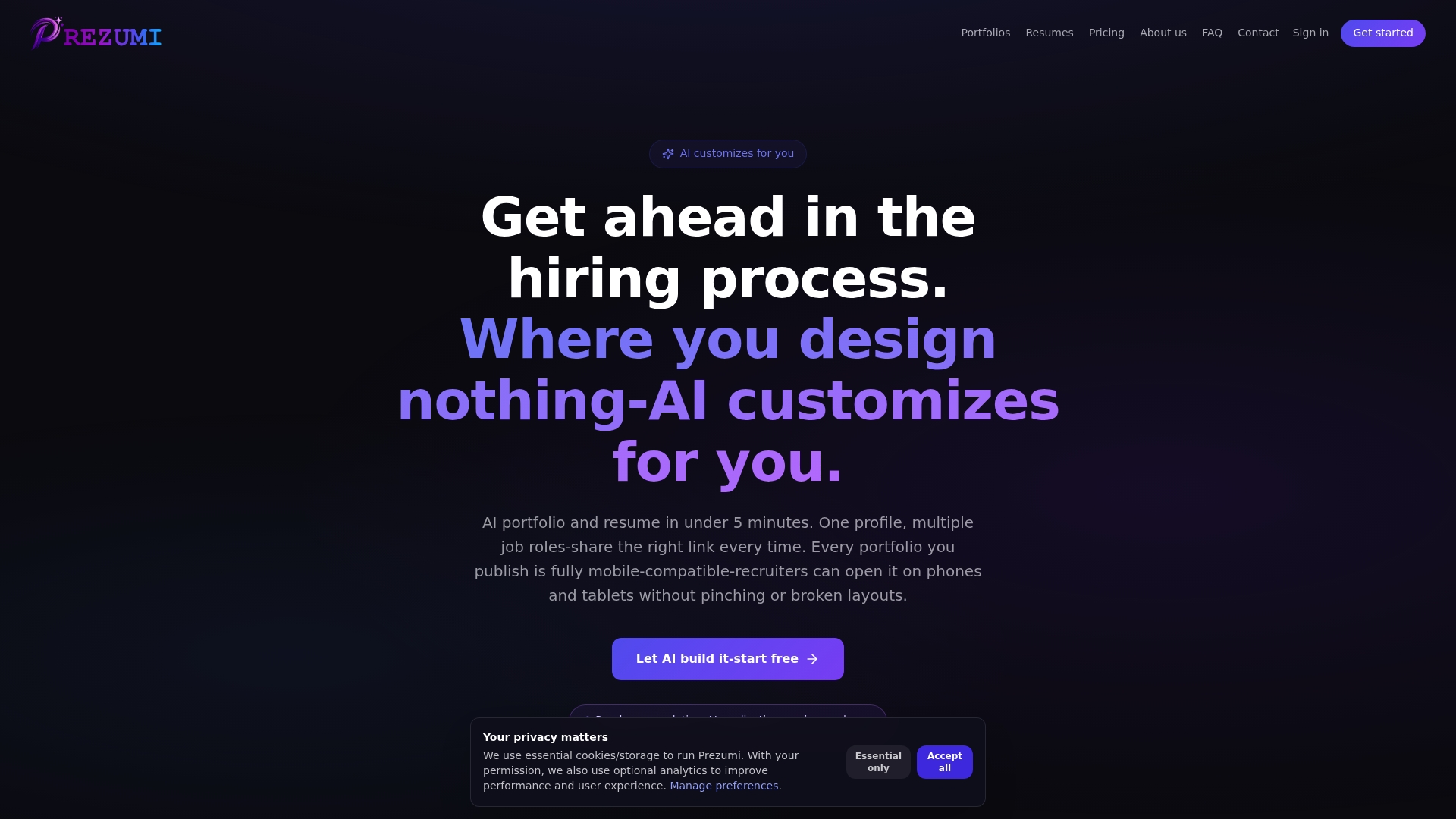
Prezumi's AI-powered platform gives students, freelancers, and job seekers access to recruiter-ready templates built around the exact principles covered in this article. The minimal resume template keeps your content front and center with a clean, ATS-friendly layout. The blueprint resume template is ideal for professionals who want a structured, achievement-forward format. Both templates include AI editing support to help you sharpen bullet points, surface measurable results, and tailor your resume to specific roles in minutes, not hours.
Frequently asked questions
How do I tailor my resume for each job application?
Review the job description and include relevant keywords, skills, and experiences that match what the employer is seeking. This improves both your ATS fit score and your appeal to the human reviewer who sees it next.
Do certifications really help more than degrees?
Recent benchmarks show certifications outperform degrees in resume acceptance rates by about 41%, especially in skill-based hiring where demonstrated ability matters more than credentials alone.
What is the best way to present soft skills on a resume?
Use the STAR method to describe soft skills within your work history, showing real scenarios where you demonstrated those abilities. Emotional intelligence and learning agility are especially valued when backed by concrete examples.
How do I address gaps in my resume?
Describe the gap honestly, highlight transferable skills gained during that period, and add relevant credentials to show continued growth. Career changers who acknowledge transitions and frame them with purpose consistently perform better in recruiter reviews.
How important is proofreading in resume improvement?
Extremely important. Typos signal inattention to detail and can disqualify an otherwise strong candidate before a recruiter finishes reading the first section.